HONOR ROLL #113, APRIL 20

 Better known for  spaghetti westerns, GEORGE ARDISSON also threw his hat into the spy ring.


BEN BROWDER and CLAUDIA BLACK, the "Brangelina" of the spaceways.


JANY CLAIR gets her Moon Men to drive Hercules looney.


GIGI EDGLEY kept her fans on the edge of-- something or other.


How did Gamera's worst enemy justify eating people? "Hey, GYAOS will be GYAOS."


TOM HOLLAND, are you E.T. in disguise? You keep wanting to "go home" all the time...


NEW SETUP

Even when I started the blog last year, I didn't think I could continue indefinitely to come up with six entries for every chosen letter, or grouping of letters, given that I'm drawing on a finite number of reviews on my NUM blog. 

So for the edification of the one or two people reading, I'm still going to recapitulate six reviews, alphabetized by significant actors from the productions reviewed, but it's going to be six different letters per post. I might even get adventurous and-- skip over a letter, or letter-grouping-- in order to get to something I want to highlight. In the next post, for instance, I'm going to skip over one letter for that purpose.

I also won't necessarily keep the same order of the categories, though I still want to make a "costumed crusader" post the last of the six.

Example forthcoming.


DC SUPER HEROES: THE FILMATION ADVENTURES (1967/2008)


PHENOMENALITY: *marvelous*
MYTHICITY: *poor*
FRYEAN MYTHOS: *adventure*
CAMPBELLIAN FUNCTION: *cosmological*


Much as I liked these old interstitial cartoons from the 1960s Filmation Studios AQUAMAN teleseries when I was a kid, I never expected that they’d be given their own DVD. I would have thought that if they showed up anywhere, it would’ve been on a multi-disc DVD for AQUAMAN. For whatever reason, though, there’s now a separate DVD set just for the King of the Seven Seas. Thus, what we have here are six “micro-serials” devoted to popular DC comics-franchises—Flash, Atom, Green Lantern, Hawkman, Teen Titans and Justice League— wherein each franchise got three seven-minute cartoons apiece. Originally each individual cartoon would be broadcast in between two Aquaman cartoons. This program provided the first animated adaptation for all of these features, but the exposure didn’t lead to any spin-offs, though they may have given Saturday morning programming execs a little more familiarity with the DC characters, which MIGHT have abetted the 1970s launch of the long-lived SUPER RIENDS program. That said, whoever produced the packaging of this 2-disc set was apparently confused about who lived in the DC universe, given that the images for the discs’ “main menu” screens include the character Birdman, who originally appeared in his own 1960s show from the Hanna-Barbera Studios.


The three ATOM cartoons are among the weakest offerings, since the extremely limited Filmation animation couldn’t really put across the athletic appeal of the Tiny Titan. The one episode of any interest pits the hero against a rogue scientist with control over mutated plants. This villain may have been loosely modeled upon the Plant Master character from the ATOM feature. The other episodes, concerning alien beetle-men and a standard mad scientist, are forgettable.


The FLASH cartoons—two of which co-star the hero’s juvenile sidekick Kid Flash—aren’t much better, since the animation couldn’t convey the excitement of running really fast. The biggest trick in the bags of these two Flashes is being able to vibrate through walls, and that trick isn’t enough to give much oomph to episodes about a giant mutated ant and a robot-making mad scientist. Slightly better is a story about an alien criminal speedster named Blue Bolt, who for some reason obtains speed-powers when he touches down on Planet Earth, and who creates havoc on the planet until he’s tossed back into space.


The GREEN LANTERN episodes, though, are the best of the offerings, and that may be because the titular hero, in place of fast physical action, employs a lot of fancy rays and energy-constructs in battling other SF-themed foes. It’s the only interstitial cartoon that’s totally faithful to adapting a DC Comics villain, a fellow named Evil Star who has a nice “dueling energy constructs” battle with the hero. The SF-theme also gives this micro-series access to more outre material, such as an evildoer seeking to release space-criminals from a dimensional rift while imprisoning Green Lantern and his friend Cairo in that otherverse. Cairo, incidentally, is a blue-skinned Venusian teenager who works for the Lantern’s other ID Hal Jordan. I assume Cairo was loosely based on "Pieface" Kalmaku, the (fully adult) Eskimo sidekick of the comic-book Green Lantern, though this blue-skinned youth talks hip-talk along the lines of the Justice League mascot Snapper Carr. Cairo provides a small dollop of comedy relief, which is more than Tusky the Walrus ever did for Aquaman.  


It was inevitable that a character like Hawkman, with an extremely complicated comics-backstory, would get simplified as much as possible. Thus, this version of the Winged Wonder is an alien scientist who, for no particular reason, lives on Earth masquerading as a Terran scientist while dressing up in hero-gear to fight alien invaders. Filmation rather logically dispenses with the original character’s penchant for archaic weapons and gives him talon-gauntlets that can fire various rays, much like the power bands of Hanna-Barbera’s Space Ghost. (I confess as a kid I quite liked the gauntlets, but I don’t think the comics-character ever used anything comparable.) Hawkman also has an eagle mascot, Skreel, who’s surprisingly not played for any comedy relief. All three episodes deal with routine alien menaces, though one tale boasts an interesting archaic name. Hawkman journeys to an alien world to rescue some Earth-astronauts from the denizens there, who worship a graven image by the name “Pythorex.” This sounds like faux-Greek for “King Python,” so I assume the writer knew of the tradition in which Greek oracles communed with a spirit, sometimes called “Python,” in order to make their predictions. To be sure, neither the statue nor its worshipers predict anything; instead the graven image boasts a forehead-gem that can mesmerize people, which is slightly reminiscent of the three-eyed statue in the 1940 THIEF OF BAGDAD.


The Justice League cartoons offer some pleasure in seeing how the scripts juggle the various powers of the heroes—Superman, Flash, Atom, Green Lantern, and Hawkman (but not Aquaman!)—as they ward off more alien threats. The only villain worth mentioning is an extraterrestrial villain named Mastermind, who nearly kills Superman in a kryptonite trap.


Sadly, the Teen Titans cartoons boast the dullest scripts, and there’s not as much colorful use of the respective powers of Aqualad, Kid Flash, Speedy and Wonder Girl. These three cartoons’ only distinction is that they’re the first cartoons to adapt a comic-book superheroine, so that Wonder Girl arrived on the adaptation scene before her “sire” Wonder Woman. Not that the Amazon Princess gets much to do, since in one episode, she appears to faint when a huge monster roars in her face!


The DVD set also includes a short documentary on the life of Filmation exec Lou Scheimer. However, the set egregiously omits the best thing about the interstitial cartoons: a rousing, albeit extremely corny, theme song, to wit:


SupermanAquaman!
All the super-duper heroes,
They always fight for what is right!
Live with danger and adventure,
They are Men of Might!

Superman, the Man of Steel
Performs super deeds with ease!
Aquaman's the bold and daring
King of the Seven Seas!

Hawkman, from another planet
Swoops down on the foe!
Nothing stops the Teen Titans
Anywhere they go!

Flash defies the eye to follow
With his super speed!
Against the force of evil
The Atom will succeed!

Green Lantern's power ring
Can accomplish anything!

Superman! Aquaman!
All the super superheroes
Are the Justice League of America,
Men of Might!


RESIDENT EVIL: DAMNATION (2012)


PHENOMENALITY: *marvelous*
MYTHICITY: *fair*
FRYEAN MYTHOS: *adventure*
CAMPBELLIAN FUNCTIONS: *sociological*


The animated film DAMNATION-- the second film of its kind, and released in the U.S. slightly after RETRIBUTION-- manages to keep some of that old kickass feel. Again, since I don't follow the games, perhaps I enjoyed DAMNATION better simply because it was my introduction to two new characters, American soldier Leon S. Kennedy and devious spy-girl Ada Wong.  Wong actually shows up in RETRIBUTION as well, but her character in the live-action movie lacks the gusto of the animated version.  In addition, DAMNATION, in addition to the usual slobbering alien-predator mutant monsters, benefits from a strong villain, lady president Svetlana Belikova of the "Eastern Slav Republic."

I can't say that either film's plot stuck with me very long, but DAMNATION scored with me by creating some incidental characters-- albeit characters doomed to perish almost immediately-- a small band of Slav rebels attempting to fight Belikova but also attracted to American pop culture.  In contrast, RETRIBUTION was just the same old group of recurring characters, and so proved a little on the boring side.  Possibly Paul Anderson took it easy with this one while warming up for his supposed big finale.

FLESH GORDON (1974)


PHENOMENALITY: *marvelous*
MYTHICITY: *fair*
FRYEAN MYTHOS: *comedy*
CAMPBELLIAN FUNCTIONS: *sociological, cosmological*

FLESH GORDON is a pretty good sex-comedy send-up of the Universal "Flash Gordon" serials. Reportedly Universal Pictures tried to block it with a plagiarism suit, and this may have engendered the prefatory title-card before the film begins, wherein the producers attempt to convince the public of their deep regard for such "superheroes" as Flash Gordon, Buck Rogers, Superman and Captain Marvel.

Though I'm sure the producers' main concern was to make a buck, FLESH has its moments if one takes it on its own terms as pure farce, without expecting to see any satirical barbs against the venerable space-opera of comic-strip and movie fame. The narrative's sole concern is to replay the familiar setups of the original 1936 serial-- albeit with a few touches taken from other FLASH movies-- and to jazz up their sexual content.

This isn't altogether inappropriate, for both the early comic strip and the first of the three serials are replete with tons of sumptuous sexual imagery. The other two serials and the strip in its later days become considerably toned down into simplistic space opera, but sexuality was a major part of the early FLASH. Note this tableau from the first serial, showing five of the main players: noble Flash, who wants Dale but who is desired by nasty Princess Aura, while to the side you see both Ming and Vultan, both of whom made unsuccessful assaults on Dale's chastity.


Though FLESH GORDON is never more than baggy-pants comedy, I can appreciate that the producers didn't indulge in a lot of irrelevant silliness, but stuck with their one basic trope: jazzing up the sex in the extravagant situations. Whereas the story originally started out with Earth being menaced by cataclysms brought on by the approach of Ming's wandering planet Mongo, now "Wang the Perverted" of "Porno" bombards the Earth with sex-rays, causing all affected to do the nasty with each other. Flesh, "Dale Ardor" and "Flexi Jerkoff" journey to Porno, though they are hit by the sex-rays en route and enjoy a (not very explicit) three-way. Once the threesome arrive on Porno, Wang takes them prisoner. He decides to keep Dale for himself, to put Flexi to work in the labs, and to hurl Flesh to the arena to be killed. In the 1936 serial, Flash fights two muscular men with fangs, who try to kill him: in place of this, Flesh fights fanged women who might be trying to hump him, kill him, or both. I imagine that this might become tedious for some viewers, particularly since the sex-scenes aren't all that good, but I preferred the repetition of one okay joke in place of a dozen bad ones.

I mentioned that FLESH sometimes borrowed from later serials. The film doesn't parody the devilish Princess Aura, who seeks to seduce Flash away from Dale, but it does, strangely enough, reproduce a MAD-ized version of Queen Azura, who appeared in the comic in 1935, and in the second FLASH serial in 1938. The film gives viewers a "Queen Amora" who can magically vanish like the one in the 1938 serial, and who spirits Flash away from Ming's court, has sex with him, and then gets unceremoniously killed-- which made me wonder why the writers even bothered with her.

Of course, many of the jokes fall flat. I didn't mind that the film's version of Prince Barin is gay-- after all, his main role in the strip is to be Aura's consolation prize when Flash refuses her-- but "Prince Precious" just isn't funny. There are other predictable riffs: ships that look like phalli, "penisauruses," "rape robots," and a gigantic idol who comes to life and flashes the middle finger at his foes. It's all pretty routine, but happily the three main actors playing Flesh, Dale and Flexi play it generally straight, reacting to all the lunacy just as stolidly as the serial-characters. Jason Williams is a particularly good road-company Flash Gordon, and doesn't make the character sappy like the actor who took over the part in 1989's FLESH GORDON MEETS THE COSMIC CHEERLEADERS. Also, Flesh may be in a silly world, but he's given as much combative chutzpah as Buster Crabbe in his day, so this comedy falls into the combative mode.

WIZARDS OF THE LOST KINGDOM II (1989)


PHENOMENALITY: *marvelous*
MYTHICITY: *poor*
FRYEAN MYTHOS: *adventure*
CAMPBELLIAN FUNCTION: *metaphysical, psychological*


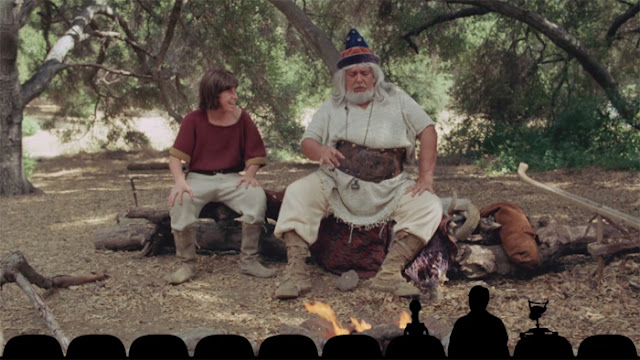
As the above still indicates, I watched a MST3K version of WIZARDS II for this review. On occasion I'll find the bot-chatter too distracting from the actual film, but in this case there wasn't any dissonance. WIZARDS II is making fun of itself quite as much as any routine on the Satellite of Love.

The only connection between this film and the original WIZARDS  is that producer Roger Corman ostensibly made money with the first one, and so he greenlighted a "sequel" in name only, directed by Corman's long-time collaborator Charles B. Griffith, who co-wrote the script with one Lane Smith. (Lead actor Mel Welles had also co-scripted an earlier film with Griffith, 1965's SHE BEAST, so I would hazard that Welles might have contributed some of his own lines to the mix.) Not that anyone should be proud of the WIZARDS II script. 

I find myself debating over which WIZARDS was worse. The Ed Naha script for the first film was just as sloppy as the Griffith-Lane narrative, in that both are content to recycle fantasy-tropes at their most stereotypical level. But in Naha's story, there was at least the germ of a Freudian fantasy-- Bad Mommy and Bad Daddy kill Good Daddy, after which Bad Daddy tries to make it with the Good Daddy's Good Daughter. The Griffith-Lane script is designed to do nothing but mark time, giving its heroes a collection of empty quests to complete before the film comes to an end.

Griffith may at least have sought to duplicate one aspect of WIZARDS I. The first flick focuses on the avuncular relationship of a wise old Han Solo figure to a naive young Luke Skywalker character. WIZARDS II spends most of its time on elderly magician Caedmon (Welles) tutoring the Chosen One Tyor (Bobby Jacoby) in magic, so that together they can overthrow Loki, Donar, and Zarz, the three tyrant-wizards who rule the land. (Why give just one wizard a nonsense-name while the other two get the cognomens of Earth-gods? Who knows?) Caedmon converts Tyor to the cause with nearly no argumentation at all, though, being that this is a Corman film, Caedmon may have whispered to the youth that he'd get to see a lot of female booty on the quest.

Not all of the magicians' allies are female. One is a master swordsman, The Dark One (top-billed David Carradine in a really bad wig), and there's another guy, Erman, who appears for one sequence and then vanishes. However, the magi also get aid from a swordswoman named Amathea, played by Lana Clarkson, who essayed a heroine with the same name in an earlier Corman-production, BARBARIAN QUEEN. Possibly Clarkson was cast just so that Corman could once again plunder old footage from that film in order to save bucks on WIZARDS II. Another ally is a dancer (Susan Lee Hoffman), whose big moment consists of breaking a guard's neck with a leg-lock. In addition, Caedmon and Tyor also encounter a trio of captive ladies held by a demoness, and a hot young henchwoman of Donar's tries to seduce Tyor (a motif which may have been borrowed from WIZARDS I).

There's a lot of fighting, with both swords and sorcery, but it's pedestrian at best, though Clarkson comes off best-- certainly better than Carradine, who looks bored even in the battle scenes. As noted before, though this is isn't a full-fledged comedy, the script is full of tongue-in-cheek anachronisms and clumsy attempts at double entendre, as when Tyor threatens the hot henchwoman with a sword, saying, "Show me where the sword is, or I'll skewer you like you've never been skewered before." 

WIZARDS II does have the edge over the previous film in that Two has more familiar faces with which to conjure. Bobby Jacoby, veteran of various teen comedies, was at least a more competent performer than Vidal Peterson, and Welles at least commits to his silly role better than did Bo Svenson. The script brings together, albeit briefly, two actors best known for their villains: Sid Haig of BIG BIRD CAGE fame, and Henry Brandon, who rendered the best portrait of Sax Rohmer's devil-doctor in THE DRUMS OF FU MANCHU. (WIZARDS II was also Brandon's final film.) But since the jokes aren't funny and most of the action is boring, I guess that Naha's WIZARDS wins the contest, such as it was.

PROJECT SHADOWCHASER I-II (1992, 1994)


PHENOMENALITY: *marvelous*
MYTHICITY: *poor*
FRYEAN MYTHOS: *adventure*
CAMPBELLIAN FUNCTIONS: *cosmological, psychological*


I had seen PROJECT SHADOWCHASER III years ago on cable, and for many years had no idea what the other installments were like. YouTube gave me the chance to find out. (Note: Part III is not reviewed here as it is not a combative film.)

The opening film from 1992 is essentially "Die Hard with a Killer Android."  In a near-future setting some terrorists break into a government installation. There they find and liberate an intelligent android being kept on ice. The android, name of Romulus (Frank Zagarino), takes over the gang, and they invade a high-rise hospital in order to kidnap the daughter of the president.  More or less by accident, the authorities also unleash a convict from cryo-sleep, name of DaSilva (Martin Kove). To keep his freedom DaSilva braves the high-rise and begins knocking off terrorists in the approved John McClane manner, with a little help from the aforesaid daughter (Meg Foster). It's a tolerably executed cheesy action-flick with decent direction from Jon Eyres, also the director on the other two in the official series.


Next up is 1994's SHADOWCHASER II, aka NIGHT SIEGE. Although Romulus appears to be destroyed at the end of the 1992 film, again an android-- this time without a name, but identical in appearance and again played by Zagarino-- recruits a bunch of terrorists. With this gang he proceeds to take over a nuclear plant, apparently in the hope of triggering armageddon. This time the tough McClane-clone is Frank (Bryan Genesse), a janitor at the nuclear facility, who for no clear reason is a master of the martial arts.  Of the three films, this one puts forth the best hard-hitting fight-scenes, particularly a face-off between Unnamed Android and Forgettable Janitor-Hero at the conclusion.  Female lead Beth Toussaint is both a physicist at the plant and a working mom, so of course her young boy arrives during the chaos in order to up the tension a bit.