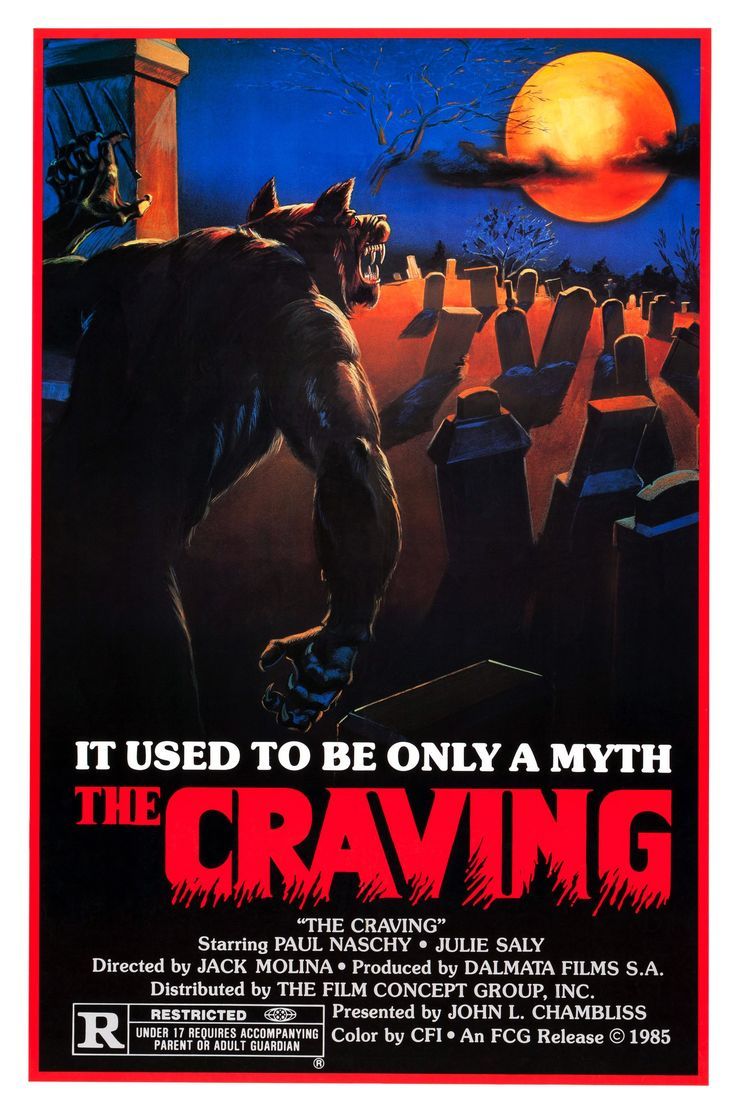
THE CRAVING (1981)


PHENOMENALITY: *marvelous*
MYTHICITY: *fair*
FRYEAN MYTHOS: *drama*
CAMPBELLIAN FUNCTION: *metaphysical*

The ninth film in the "Hombre Lobo" series also goes under the title NIGHT OF THE WEREWOLF, which is serviceable enough, though the video title THE CRAVING has the advantage of making the customer wonder who's doing the craving and what they're fancying. CRAVING is substantially a remake of 1971's THE WEREWOLF VS.THE VAMPIRE WOMAN, though with a number of references to other horror films worked in. 

Once again the legend of Waldemar Daninsky (Paul Naschy) gets rebooted. This time he starts out as a nobleman in 15th-century Hungary, condemned to death for the Satanic activities he undertook with his mistress Elizabeth Bathory (played by Julia Saly and based on the real-life mass murderess of the same name). The trial scene apes elements of Bava's 1960 BLACK SUNDAY, wherein a vampire-witch and her servant were executed in medieval times, but in CRAVING, Waldemar is already a werewolf, so he must be sealed in a crypt with a silver cross. (Note: in the 1971 film, a silver cross was used to restrain the titular "vampire woman.") Bathory is executed and consigned to a separate tomb.

Fast-forward to 20th century Europe: Erika, a student of black magic, decides that she wants to resurrect Bathory, and even kills an old professor to gain access to his records. She then talks two other students, Karen and Barbara, into joining her on a trip to the Bathory tomb in Hungary. But before they reach their goal, a couple of unwise tomb-thieves (almost surely copied from a similar pair in FRANKENSTEIN MEETS THE WOLF MAN) invade Waldemar's tomb, swipe the silver cross, and inadvertently revive the werewolf. As in the 1971 film, the recrudescent lycanthrope then somehow gets hold of an estate, so that when the three lissome ladies arrive, he's there to save them from vile rapists with his trusty crossbow, and then to invite them to his home.

Since Waldemar always charms at least one lady per film, this time it's Karen who exchanges goo-goo gazes with Waldemar. This dalliance possibly distracts Waldemar, who has no desire to see his former mistress revived, so that Erika successfully brings Bathory back to life. Bathory sets about vampirizing various locals, particularly hot young women, until Waldemar unleashes his inner wolf and the two fiends battle it out. The fight is better choreographed than the one from 1971, though the ending is more doleful, for Waldemar kills his love even as she kills him.

The budget for CRAVING was higher so that the makeup and photography counts among the best for the Hombre Lobo series, though it never conveys the dreamlike mood of WEREWOLF VS. THE VAMPIRE WOMAN. Though the Naschy-wolf often encountered other monsters, most were generic types-- a mummy, a yeti, etc. Thus CRAVING is the only one in which El Hombre Lobo meets an "established" monster, even if it is a fictionalized version of the historical Bathory, making this the only true crossover in the series.


BLADE TRINITY (2004)


PHENOMENALITY: *marvelous*
MYTHICITY: *fair*
FRYEAN MYTHOS: *adventure*
CAMPBELLIAN FUNCTION: *cosmological, sociological*


I haven't seen either the one film David S. Goyer directed before he wrote and directed TRINITY or the two he did afterward. But despite Goyer's unquestionably limited directorial resume, I think he did a respectable job with the film, as good as Norrington's first installment with the Blade character and much better than Del Toro's "Cthulhu-vampire" outing.

Of course, many people didn't like the fact that main hero Blade (Wesley Snipes) shared the screen with a band of human vampire-hunters, loosely based on a group of Marvel characters called "the Nightstalkers." Snipes himself reportedly had major problems sharing the screen, and his sentiments made for a difficult shoot-- which makes it all the more impressive that TRINITY turned out as well as it did. It's quite possible that the movie's producers hoped that this film would spawn a Nightstalkers franchise, which didn't happen because TRINITY didn't do nearly as well as the second installment. What the movie's detractors fail to apprehend is that (1) Movie-Blade is a pretty dull, affect-less figure if he doesn't have more emotive characters off which to play, and (2) the script dealt with an epic threat that Blade alone could not have coped with.

The evil vampires, mostly the traditional type this time out, have a two-pronged scheme in mind. They've managed to find and revive the first vampire in history, who's as old as Sumeria and now goes by the name Drake (Dominic Purcell), though he's the inspiration for the mythic figure of Dracula. But to get Blade out of the way, the vamps use their network of human familiars-- who never seemed to be very important in the first two flicks-- to frame Blade for murder. The intervention of human law enforcement brings about the death of Blade's mentor Whistler (Kris Kristofferson) and Blade's capture. Number Two Vamp Danica (Parkey Posey) lays plans to obtain Blade from the human police, but the Nightstalkers rescue him first.

I will admit that most of the Nightstalkers are pretty forgettable, and the only ones who survive to the end anyway are Whistler's daughter Abigail (Jessica Biel) and Hannibal King (Ryan Reynolds, playing the only other movie-character derived from a Marvel original). Blade gives his fellow heroes lots of attitude, calling them "amateurs." Yet he still accepts (with zero gratitude) their help in seeking to thwart Drake's master plan: to eliminate most of humanity and use the remainder as perpetual "blood banks." Not only do the Nightstalkers supply some vital weapons, their scientist comes up with a bioweapon potentially capable of wiping out all bloodsuckers, though Blade himself, being half-vamp, might be a casualty.

While TRINITY is no adventure-classic, it displays the best story-boarded action sequences. Admittedly, while Biel's heroine brings a lot of stalwart intensity to the table, Goyer's version of Hannibal King cracks a few too many lame jokes. Purcell's burly Drake makes a welcome change from the majority of cinematic Draculas, though I could have lived without the part of the climax where Drake transforms into some sort of Sumerian demon.

And so ended the original BLADE trilogy (which would have made more sense than "trinity.") Though there was later talk of Snipes reprising his take on Movie-Blade, I for one felt it something of a dead end. None of the installments are great adventure films, but at least two of the three are solid formula-flicks, and unlike the current crop of comics-adaptations, they all happily avoided the pretentiousness of politicization. 


THE MATRIX REVOLUTIONS (2003)


PHENOMENALITY: *marvelous*
MYTHICITY: *fair*
FRYEAN MYTHOS: *adventure*
CAMPBELLIAN FUNCTION: *metaphysical, sociological*


The largest of the "Little Reveals" in MATRIX RELOADED appears near the conclusion. Neo has returned to his human form of Anderson, and is attacked by some of the AI machines invading Zion. Anderson actually destroys the mechanical juggernauts with some unexplained force; a thing he should not be able to do in the real world. Anderson then falls into a coma, so that REVOLUTIONS picks up with his allies not knowing if their predicted "savior" can even save himself.

This idea of humans gaining powers thanks to their exposure to the computer-simulation ought to be a major plotline in the final film. Instead, the Wachowskis seemed to lose track of that element, concentrating instead on how Anderson's mentality, though not physically "jacked in" to any computers, somehow projects itself, as Neo, into a "transition space" between the real world and the simulation. The hero meets other sentient programs but is initially unable to escape. 

Trinity and Morpheus seek to gather intelligence in the Matrix while Zion continues to lay defense plans for the encroaching machine-army. Trinity and Morpheus are able to liberate Neo, though the matter of Anderson's psychic powers still receives short shrift. The hero's nemesis Smith has begun to extend his influence into the real world, taking control of a Zionite named Bane. 

Anderson, returning to the real world, does not know this when he and Trinity pilot a Zion ship to the nerve complex of their AI enemies, known as "the Machine City," in order to seek some rapprochement. Bane reveals his true nature to Anderson, astonishing the human at this incursion. The two fight, and Bane blinds Anderson, though he's able to use his new psychic ability to sever the connection between the human puppet and its puppeteer. 

The ship nears the Machine City and is attacked, at which point Anderson finally again uses his telekinetic power on some of the robots. However, the ship crashes and Trinity, spared from death in RELOADED, is killed. Anderson does succeed in making common cause with the AIs, who are aware that Smith is the greater threat. Thus he returns to the Matrix as Neo and has yet another super-battle with Smith which, while very good, is no match for the Burly Brawl.

There are some decent philosophical moments here, as when Smith tells Neo he realizes that all life has purpose, and that its purpose, whether organic or AI, "is to end." But though this sells the idea of Smith as an avatar of Death more than just a rogue program, the creators have still lost control of the mythopoeic thread that seemed to unite the original film. What remains is just another "salvation of the human race" conflict. 

I don't imagine my specific disenchantment with the myth-discourse relates strongly to the reasons that moviegoers didn't respond as well to REVOLUTIONS as to its predecessors. 

But I don't know that those reasons didn't include some sense of a potential that somehow, just didn't get realized.

HONOR ROLL #219

CARRIE-ANNE MOSS plays the Schrodinger's Cat of futuristic heroes-- dead, then alive, then dead again.


Before DOMINIC PURCELL, who ever thought of Dracula looking like a soccer hooligan?


JULIA SALY's got a craving for werewolf blood.


Nobody plays a sex-demon as demonically as ANTHONY WONG.


BREC BASSINGER charts a short but stellar future.


Blue Demon explains to MARTHA CERVANTES that her next role is to play a brain-sucking spider, and she's totally into that.


THE PUNISHER (2004)


PHENOMENALITY: *uncanny*
MYTHICITY: *fair*
FRYEAN MYTHOS: *adventure*
CAMPBELLIAN FUNCTION: *sociological*


Though the marketing for the second PUNISHER film places considerable emphasis on the Marvel hero wearing the skull-costume denied him in the 1989 movie, Thomas Jane doesn't really spend a helluva lot of time in said costume. Without that "outre outfit" and the one "diabolical device" in the story (a ballistic knife), I might still categorize the movie as "uncanny" thanks to the protagonist's mission to take down all criminals.

I've not read any of the comics-stories on which the film is ostensibly based. However, I tend to doubt that Marvel did a version of Punisher that deviated so sharply from his established origin. In the original tale-- which may have been "borrowed" partly from the first Don Pendleton EXECUTIONER paperback-- ex-Marine Frank Castle and his family witness a mob execution in Central Park. The mobsters shoot them all, but Castle survives to become the Punisher, warring on all criminals.

This time out, Castle is an undercover FBI agent. His imposture of a gangster eventuates in a raid on a smuggling operation headed by one Bobby Saint. Bobby dies, and his mafia-boss father Howard Saint (John Travolta) moves heaven and earth to learn the identity of the agent who caused his son's death. Saint's minions, led by enforcer Glass (Will Patton), assault a family reunion and kill a few dozen people, including Castle's wife. But despite the agent's formidable gun-skills Castle is shot and thrown into the sea.

He survives, and weeks later rather remarkably reveals that he's still alive to the police, apparently to shame them for not catching the killers. Even more remarkably, the cops don't try to take Castle in for questioning-- which shows that the scripters just wanted a dramatic scene no matter how improbable. Said scripters are director Jonathan Hensleigh, who had peaked in the nineties with the silly but amusing ARMAGEDDON, and Michael France, whose only good piece of writing was his partial contribution to GOLDENEYE.

After holing up in an abandoned apartment building, where he ends up forging unwanted bonds with the three quirky residents, Punisher lays his scheme of revenge. Rather than making a frontal assault, the hero decides to repay the loss of his family by alienating Saint from his various allies and family members. This operatic plot does give Travolta and Patton a lot of dramatic moments, but it takes some of the expected punch out of the hero's usual ultraviolent pattern. When Hensleigh does finally unleash some action set-pieces, they're watchable, but nothing to write home about.

Jane makes a decent hero, and he does pull off the affect-less persona of the Punisher fairly well. He's a little too Hollywood-handsome to fit the role, though I suppose he fits this overall project, which is just adequate action-movie fodder and nothing more.


THE TUXEDO (2002)


As bad as HEAT is, though, I would say THE TUXEDO is worse, perhaps because Jackie Chan has more talent in one foot than Joe Piscopo has in his whole body.

Chan plays Jimmy Tong, a Chinese-American who drives a taxi and longs after a pretty Chinese woman, though he can't work up the nerve to ask her out. He gets a job as a personal driver for a smooth fellow named Clark Devlin (Jason Isaacs). Devlin takes a fancy to Jimmy and lets Jimmy see his ritzy apartment, though he warns the driver not to touch a special case with a tuxedo inside. Their conversations suggest to Jimmy that Devlin is a James Bond-like superspy, and Jimmy asks his employer for advice on girls. Jimmy acts toward Devlin like a mentor, even though at the time Chan, pushing fifty, was almost ten years older than Isaacs.

Then Devlin appears to perish in an exploding car, and Jimmy, having only rudimentary knowledge of the spy's agenda, decides to seek out his killer. He dons the mysterious tuxedo and finds that it's a genie's lamp that can do almost anything: prompt him with the knowledge he needs in any situation, or force Jimmy's unskilled body to perform athletic wonders. By dumb luck Jimmy contacts a newbie spy from Devlin's agency, a young woman named Del (Jennifer Love Hewitt), and convinces her that he's the legendary Clark Devlin. Together they investigate a terrorist corporation out to pollute U.S. reservoirs with a fairly ingenious plot involving "water strider" insects.

As in many of his later films, Chan mugs through his part, while Hewitt tries to match his lunacy by playing her character as equally loopy. Chan's role seems like an idea that might've worked a little better for a younger actor, particularly with respect to his mooning over an unrequited love, but the actor's attempts to act cute at nearly fifty years of age are doomed from the word go. In some scenes Chan is aided by FX to accomplish his stunts, but there are enough real athletics to please the devoted Chan-fancier. But in my case, the lameness of the superspy routine and the paltry characterizations make THE TUXEDO inferior even to a dog like DEAD HEAT.

KRAA THE SEA MONSTER (1998)


PHENOMENALITY: *marvelous*
MYTHICITY: *poor*
FRYEAN MYTHOS: *adventure*
CAMPBELLIAN FUNCTION: *cosmological*


KRAA is a silly but spirited salute to both giant monster films and the micro-budgeted space operas of 1950s TV. If one goes into the film expecting it to boast even middle-range FX, one will be disappointed. But without overrating what KRAA offers, I thought the actors were relatively engaged with their broadly played roles. It's not broad enough to be truly "tongue-in-cheek," much less outright comedy, but it manages to be fitfully amusing.

Most giant monster films are primarily about the giant monsters, even when they're sent by some vague prime movers. But the monster in the film's title is just a mindless tool of his creator, an alien overlord named Lord Doom (Michael Guerin), sort of a mashup of Skeletor and Marvel's Doctor Doom. He begins the film discussing his project of unleashing the giant sea monster on Earth, for conquest as far as I recall. He's aware that there's a cadre of space-patrol agents, the Planet Patrol, buzzing around the Earth, but is confident they can do nothing. 

However, the patrol agents have an agent whom they send to Earth to somehow counter Kraa's rampage. However, for some reason I forget, the agent is a tiny fellow named Mogyar, who has some "universal translator" problems that result in his speaking English in an Italian accent. Mogyar makes contact with two random humans, Bobby and Alma, and the three of them try to figure out to defeat Kraa while also dodging government agents. It's all moderately watchable but forgettable. The film then has the Planet Patrol zoom all the way to Lord Doom's world, where Doom has a short battle with the patrol-commander before being defeated. However, a coda establishes that Doom may escape once again to menace the cosmos.

A lot of similar stories might have focused upon the heroic figures who defeat Doom and his monster. However, neither the Earth-humans nor the space-patrol officers stand out. So in my view KRAA is the only giant monster-film in which the villain is the star, though the sixties film TERROR BENEATH THE SEA is similar in its structure.