HANNA (2011)


HANNA is exactly the opposite (of THE HUNGER GAMES) in its balance of turmoil and action, though it also deals with a young female protagonist caught up in life-or-death conflicts.  The story, taking place in a present-day milieu, is only nominally *marvelous* in that Hanna (Saorise Ronan) has been genetically engineered to become a super-competent fighter with implicitly above-average strength.  The C.I.A., who engineered this genetic experiment, loses Hanna to rogue agent Erik, who raises her in selusion deep in the snowy wilds of Finland.  However, Erik-- who poses as Hanna's father but will later be revealed to be unrelated to her-- knows that he can only keep a feisty teenager confined for so long.  He allows Hanna to choose whether or not to return to the greater world, albeit with the knowledge that she’ll instantly be pursued by the organization—particularly the former head of the operation Marissa Weigler (Cate Blanchett).  Marissa, though not technically related to Hanna, functions here as a “bad mother” against Erik’s “good father.”

 
The “Freudian family romance” suggested by this setup isn’t pursued in any depth, though Hanna does also have issues with her father once she finds out her true backstory.  The film makes several references to fairy-tale motifs, but though they add to the visual appeal of the film-- particularly an end-sequence involving a "Grimm Brothers amusement park"-- the script doesn't develop the motifs with any great depth either.
 
Though Hanna is in considerable turmoil at times—not least because she’s the typical “girl who never had a normal life”-- the emphasis of the story is on her daredevil acts.  To be sure, HANNA is not as replete with huge set-pieces as, say, the 2010 Angelina Jolie vehicle SALT.  But in my opinion the audience has been cued to anticipate not “what will Hanna FEEL next” but rather “what will Hanna DO next.”
 
The mythicity of both stories—dominantly sociological for the first, dominantly psychological for the second—rates only fair in that they evoke strong symbolic patterns but don’t take them to an exceptional level of development.


MISSION STARDUST (1967)


PHENOMENALITY: *marvelous*
MYTHICITY: *poor*
FRYEAN MYTHOS: *adventure*
CAMPBELLIAN FUNCTION: *cosmological, sociological*

I read a fair number of the English-translated adventures of the German hero Perry Rhodan, though that was a long time ago. I have the general impression that this film, the only movie adaptation of the juvenile space-series, follows the first book plot-wise, though I'm not about to reread even one of the novels to check it out.

He-man astronaut Perry Rhodan (Lang Jeffries) leads an expedition to land on the moon, looking for a rare metal. Instead the Earthmen find an alien spacecraft and its two extraterrestrial occupants, elderly Khrest (John Karlsen) and sexy Thora (Essy Persson). The aliens, who call themselves Arkonides, possess technology far beyond that of Earth, as the imperious Thora constantly reminds the Earthmen. However, she not only can't fix the stranded ship, she can't do anything about the disease infecting Khrest-- though the Earth-physician immediately figures out that it's leukemia. 

Happily, Rhodan knows of a doctor on Earth-- specifically Mombasa-- who possesses a cure for leukemia, so the expedition returns to Earth to find a cure for the alien elder-- with the astronauts hoping all the time to keep their discovery secret, to prevent any country from taking possession of the Arkonides' fantastic arsenal (including force-screens, ray-shooting robots, and so on). But one of the astronauts betrays their plan to a crime lord in Africa with the rather repetitive name of "Arkin." Arkin captures the doctor first and sends agents disguised as medical people (including sexy nurses) to make the jaunt back to the moon, supposedly to heal Khrest but actually to steal the alien weapons. Lots of ray-blasts and fistfights ensue before Arkin is defeated and the Arkonides are saved.

I seem to remember that the novel more strongly suggests that the ancient Arkonides are badly in need of crossbreeding with the more primitive but virile humans of Earth, but even if this is not the case, it's axiomatic that this is the real reason Thora constantly bags on the Earthmen; that she knows on some level that the only hope for her species is to breed with these "gorillas." Thus her every insult she hurls can be read two ways: as feminine resentment of her biological obligation, and also as a come-on to her potential lover. Rhodan, though pretty dull in all other ways, does respond by kissing her to shut her up. The Thora-Rhodan romance took up a long swath of prose stories, but here it concludes with a final liplock after the villains' defeat. Persson's irritable performance is the only thing worth watching here, not just because she's dressed in alien "hotcha-clothes," but because she makes it clear that if she REALLY doesn't like someone, she's quite willing to send the offender spinning out into deep space. The film leaves unanswered the question as to what these heroic astronauts said to their commanders about all this unsanctioned running around without reporting to HQ.


THE MONSTER SQUAD (1976-77)


PHENOMENALITY: *marvelous*
MYTHICITY: *poor*
FRYEAN MYTHOS: *comedy*
CAMPBELLIAN FUNCTIONS: *psychological*


From time to time I contemplated the purchase of a DVD collection of this hoary seventies kids' show, if only to see where it fit in the spectrum of the superhero idiom. But the vague memories of MONSTER SQUAD I had suggested that it would be money badly spent. But some generous soul happily downloaded all thirteen episodes onto Youtube, and so I was able to delve into all that seventies silliness without expense.

Most of the episodes of this program-- in which three classic monsters decide to fight the super-villains that constantly menace their city-- were written by former BATMAN '66 scribe Stanley Ralph Ross. The fact that the series is so outrageously dumb indicates that Ross had no appreciation of the camp aesthetic that made BATMAN so successful with both adult and juvenile audiences. Of course, since MONSTER SQUAD aired on Saturday mornings, there's no question that it was conceived as a kid's program. I was rather amused by an online Ross interview, in which he claimed that he was writing for "teenagers." I have no idea why he would deflect from the fact that he was writing corny jokes, with an almost total lack of sex, for an audience of grade-schoolers.

The concept by itself is engagingly stupid. Would-be crime-stopper Walter, a caretaker for a wax museum, builds a "crime computer" whose vibrations somehow bring to life three statues representing classic creatures Dracula, the Frankenstein Monster and the Werewolf (the latter two called "Frank N. Stein" and "Bruce W. Wolf.") The reborn monsters somehow have the memories of their original selves, and they decide to take up crimefighting to atone for past sins. All three actors-- Henry Polic II, Buck Kartalian, and Mike Lane-- are charged with reading all of the silly superhero-schtick with as much gusto as possible-- and in that respect, they're certainly more successful than most actors trying to emulate campy acting.


Each of the thirteen episodes offers a new villain, only a few of whom have encountered the Monster Squad before. Only two of the actors playing the villains appeared on the BATMAN teleseries: the obvious one being Julie "Catwoman" Newmar, while midget Billy Curtis had a supporting role as a henchman to False Face. Surprisingly, even though Ross wrote all of the Catwoman episodes for the 1966 show, Newmar doesn't score all that well as villain "Ultra Witch" on MONSTER SQUAD. Perhaps that's because Ross gave this project so little thought that he decided to recycle a gimmick from the Bat-episode "Entrancing Dr. Cassandra," whose big thing was a ray gun that could turn heroes into flat paper shapes. (Terrible pun alert: Ultra Witch calls her weapon "Ronald Raygun.") Surprisingly, the actors who get the best out of their silly roles are Alice Ghostley (as "Queen Bee") and Geoffrey Lewis (as "The Skull.")

Presumably Ross had nothing to do with the decor of the show, but SQUAD does successfully emulate the day-glo look of BATMAN '66. However, the fight-scenes are kept as tame as possible, as the monster-heroes fight the villains and their henchmen with things like pillows and streamers. But there's just enough minor violence-- Frankenstein making two thugs bonk heads, for instance-- that I can still deem MONSTER SQUAD a combative comedy, even though it's one of the weakest of its breed.

HONOR ROLL #133, JULY 11

 No room for JULIE NEWMAR's Catwoman round these parts, but at least her "Ultra Witch" gets in as one of the better "Monster Squad" fiends.


No stardust gets in the eyes of that imperious space-girl ESSY PERSSON.


SAORISE RONAN perks up her ears every time she hears someone say, "Holy Hanna!"


Charlize Theron gets the best lines but KIRSTEN STEWART gets her snowy name above the title.


ROBIN WILLIAMS didn't enjoy what he called "the Popeye years," but some of us liked that period better than "the RV years."


Go to ATOM ANT, thou sluggard, consider his puns and be mortified.


SANTO IN THE VENGEANCE OF THE MUMMY (1971)


PHENOMENALITY: *uncanny*
MYTHICITY: *poor*
FRYEAN MYTHOS: *adventure*
CAMPBELLIAN FUNCTION: *sociological*

Santo's encounter with an arrow-shooting mummy lacks the kinetic strength of the wrestler-hero's classic metaphenomenal adventures of the sixties. Yet it's at least a decent timekiller, thus putting it ahead of a number of dull seventies Santos.

Santo accompanies an archaeologist-friend, Professor Romero, as Romero and his expedition journey to what I assume is some Mexican jungle to look for an "Apache" mummy's tomb. Yes, the streaming translation I watched said at least three times that the people who built the tomb were "Apaches," and never used the word "Aztec," though I feel fairly sure the original Mexican script would have used the latter term. I wonder if giving the mummy a bow and arrow confused some translator? Maybe the translator was thrown by the very idea that an undead creature would use arrows even if he was "Apache."

Given that everyone in the expedition (except Santo) is a boring stereotype, it's surprising that there's a fair amount of tension as the explorers make their way to the tomb and discuss the legend of the mummy. The history of the mummy is known to the professor long before the expedition begins, though it is of course recapitulated once the tomb is discovered. The "Apache" warrior Nonoca-- whose name sounds quite a bit like that of Popoca, The Aztec Mummy-- has a love affair with Lua, a sacrificial victim who's supposed to remain pure before she's killed and sent to the gods. Nonoca and Lua, who are probably strongly influenced by the story of Universal's classic mummies, are captured and Nonoca is killed and mummified.

After the tomb is profaned in modern times, the arrow-wielding mummy shows up and starts killing the explorers. Santo never manages to prevent any of these killings, no doubt because if he tried, he would have won too easily. Given that I already categorized the film as uncanny, it should be a given that the evil mummy is really some crook in mummy-garb-- though he does give the luchador a pretty good fight at the climax. Just in case any viewers thought Santo didn't get enough action, the film's main story is bracketed by two lively Santo wrestling-bouts.

REVOLT OF THE PRAETORIANS (1964)


PHENOMENALITY: *uncanny*
MYTHICITY: *fair*
FRYEAN MYTHOS: *adventure*
CAMPBELLIAN FUNCTIONS: *sociological*

When I decided to watch this moldy-oldie peplum about the Rome of Emperor Domitian, I had no expectations of finding a new addition to my list of "superhero idiom" films. Most melodramas about ancient Rome aren't known for heroes with double identities, and so I can only assume that someone, possibly cult director Alfonso Brescia, decided to mash up the genre of the Roman historical flick with that of the costumed swashbuckler.

Domitian (Piero Lulli) is a thoroughly reprehensible despot who keeps his citizens on a tight leash, having his Praetorian Guard execute anyone who talks against the Emperor. Domitian has also alloyed the Roman court to be swayed into pagan practices by his leman Artamne (Moira Orfei), a priestess of Isis who persuades the Emperor to treat young Roman noblewomen as temple prostitutes. (Sounds more Babylonian than Egyptian, but who knows?) Two of Domitian's apparent allies, however, plan to unseat him: his jester-dwarf Elpidion and his centurion Valerius Rufus (Richard Harrison).

Rufus, hoping to generate a resistance movement in Rome, dons a wolf's head mask and begins picking fights with Praetorians, whom he beats easily with his superior strength and skill. Domitian calls for the execution of the mysterious warrior, dubbed "The Red Wolf," but the hero does the usual Zorro-esque disappearing act. (I would think that in the original Italian script someone would have drawn parallels to the legends of Rome's founders, the wolf-nurtured twins Romulus and Remus, but if so the English dub didn't trouble with that detail.)

Rufus succeeds in drumming up a resistance movement of both citizens and patricians, and the dwarf Elpidion joins him. The Red Wolf even kidnaps Artamne in order to use her as a hostage. The priestess escapes custody and reveals the hideout of the rebels to Domitian, but Rufus helps the rebels escape death. Rufus's double identity is almost exposed, but he finds that some of the Praetorians are willing to join the rebellion. This leads to a very strange end-sequence in which Rufus, the good Praetorians, and a troupe of traveling circus-performers fight Domitian's loyalists. The presence of the circus-people lends the big brawl an antic quality, for the performers use odd weapons (rolled-up bolts of cloth, a fire-eater's trick flame) and one female even floors a bad Praetorian with a judo toss! Still, all gets serious in the final duel between Rufus and Domitian, which, as one may guess, has no relation to anything in Roman history books. 


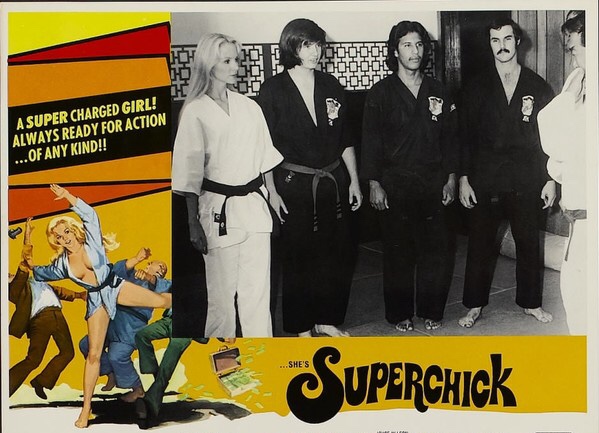
SUPERCHICK (1973)


PHENOMENALITY: *uncanny*
MYTHICITY: *fair*
FRYEAN MYTHOS: *comedy*
CAMPBELLIAN FUNCTION: *sociological*

"No one person can give another person everything he or she needs in this life."

Protagonist Tara B, True (Joyce Jillson) utters this line to one of the three lovers she visits as she jets from city to city in her peripatetic adventures as an airplane stewardess. She's justifying her refusal to be tied down by that particular lover, though he doesn't know about his competition. As movie lines go, this one does a fair job of summing up the ethic of free love. Had there been a greater quantity of such insights, then SUPERCHICK might have garnered a reputation as a Fielding-esque romp in the realms of Eros, rather than being just another tepid skin-and-sex comedy. 

Not that SUPERCHICK isn't reasonably entertaining, even when Jillson isn't getting naked on screen. Like other sex-films, its characters exist in a world where the beautiful people never "lose their charms in the end," and pretty much everything that happens to them evokes lubricious associations. The original idea for the spoofy flick is credited to its producer John H. Burrows, and it's his only writing credit among a long list of production credits ranging from 1950s westerns to the first NIGHTMARE ON ELM STREET to the 2004 RAY biopic. 

While Tara is not any deeper than the average CANDY-like naif, she's atypical in being a mistress of the martial arts, able to repel any and all unwanted attentions. She's not strictly speaking an action-heroine, in that she simply defends herself against the three or four attacks made on her-- defeating a karate master at her dojo, or beating up a half dozen motorcycle toughs (albeit offscreen). Jillson's judo probably wouldn't convince anyone looking for believable fighting, but for the purpose of showing her in charge of her body in all respects, her skills are as efficient as her cornfed good looks.

Tara's one encounter with the metaphenomenal takes place when she decides to spice up a boring afternoon in Hollywood by answering a newspaper ad offering a "unique experience" to anyone who responds. Tara legs it out to a creepy old house and meets former Hollywood thespian Igor Smith. By an amazing coincidence, Igor made his bones playing characters in "cheap horror films," just like the fellow playing Igor, the ever-busy John Carradine. Igor's idea of a unique experience is to escort Tara to a room full of torture implements, which he plans to use on her. When she asks what his mother would think, he does a PSYCHO bit, asking for his mother's approval and getting it from some upstairs room. Tara beats up the old goat and imprisons him in his own chains for later incarceration, though she also manages to convert him to masochism. All of Tara's other adventures are entirely mundane, including her final meeting with all three beaus, who agree to continue their mutual relationships with her.

I said Tara B. True (whose name evokes old timey melodrama-names like Tess Trueheart) was not technically a hero. However, the script justifies the title "Superchick" (a nickname given her by one of her lovers) by having Tara wear dowdy clothing and a dark wig to conceal her hotness while she's working as a stewardess. In the opening scene, she gets off work, enters a convenient phone booth, and emerges as a black-clad, blonde-locked hot chick. For good measure, in place of the Superman "S" chest-emblem, Tara wears a tiny "S" locket around her neck-- though the letter could stand for "sex goddess" as much as "superchick.