THE PHANTOM (1943)


PHENOMENALITY: *uncanny*
MYTHICITY: *fair*
FRYEAN MYTHOS: *adventure*
CAMPBELLIAN FUNCTION: *sociological*


THE PHANTOM serial was the first live-action adaptation of Lee Falk's comic strip, as well as the last serial production from silent-film veteran B. Reeves (UNDERSEA KINGDOM, PHANTOM EMPIRE) Eason.  Among serial fans it seems to enjoy only a modest reputation.  Most fans agree that lead actor Tom Tyler looks great in the Phantom costume, but that the serial isn't that remarkable in other respects.

Though this Columbia serial may be slightly lighter on action-elements than some of the faster-moving chapterplays, and lacks a strong villain, it does a fine job at putting across the mythic appeal of a comics-character.  The Phantom is somewhat politically incorrect these days, in that he was a white man who donned a costume in order to gain the cooperation of jungle-tribes in aiding his fight against evil. That said, THE PHANTOM fortunately plays down the racial elements of the hero's modus operandi.  As with many Tarzan films, the hero finds himself defending good white intruders, exploring Africa in the name of science, against evil white exploiters out to plunder the country or oppress its inhabitants.  In this case, the good white people are led by Professor Palmer and his daughter Diana, searching for the lost (but still inhabited) city of Zoloz, while the evil ones seek to loot Zoloz of its treasure and use it as a base for Nazi activities (though the Nazi elements also are not strongly emphasized).

Like most serials PHANTOM is extremely episodic, as the hero trails the villains, attempting to undo their evil plans at every turn.  One aspect of the "Phantom myth" that the serial successfully captures is the hero's illusion that he is an unkillable "ghost who walks."  Thus whenever the Phantom survives one of the villain's death-traps, he bolsters his legend in the villains' eyes, whereas in most serials the hero's survival connotes nothing to the villains but his extreme dumb luck.  In contrast to most serials, where the conclusion has little to do with the opening, the continuity opens with the villains killing the Old Phantom (father of the young one played by Tyler) and ends with the assassination of a phony Phantom.  Comically, one of the villains sees this and says something like, "This is where I came in."

The Phantom's "outre outfit" automatically qualifies the serial for inclusion within that category, and of course the lost city of Zoloz fits the "exotic lands and customs" trope, even if the inhabitants are rather risible in that the city-dwellers are clad in what look like castoff costumes from various historical movies  (Elizabethan guards, Mongol princes, etc)  Many jungle films use animals that aren't especially "astounding," but the hero's arena-battle with a trained ape (named "Brutus," no less) deviates from the more naturalistic applications of that trope.  Finally, this Phantom does make use of stage-magic to sell the illusion of his deathless nature; one of the few deviations from the original that seems an improvement.

Lastly, female lead Jeanne Bates portrays the first live-action version of the Phantom's perennial squeeze Diana Palmer.  Unfortunately, whereas the comic-strip heroine was relatively resourceful, this Diana faints at the sight of a killing and serves little purpose in the stories except as a cheerleader for the protagonist.
HELLSING ULTIMATE (2006-2012)


PHENOMENALITY: *marvelous*
MYTHICITY: *good*
FRYEAN MYTHOS: *adventure*
CAMPBELLIAN FUNCTION: *sociological*


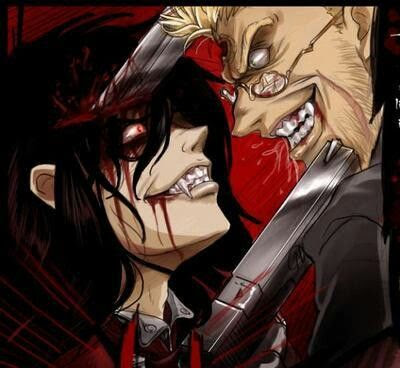
In this review I won't explore the specific plotlines of HELLSING ULTIMATE, because it's a faithful, well-executed adaptation of the 1997-2008 Kouta Hirano manga, which I've detailed here. I had the same reason not to discuss the plotline of the animated WOLVERINE ORIGIN. However, since that was a bad adaptation of a good original work. all I could discuss were the reasons that it was bad.

ULTIMATE, compared to the previous 2003 television adaptation, had the advantage of having been launched as a series of original animated videos which were begun near the conclusion of the Hirano manga. I don't have any information regarding the restrictions of the Japanese OAV market, but ULTIMATE appears far less compromised than the TV HELLSING with regard to showing the intense ultraviolence of the manga. If the viewer is primarily interested in seeing almost constant face-offs between absurdly powerful beings grimacing and shooting at one another, ULTIMATE reproduces that aspect flawlessly.

The writers of ULTIMATE are also meticulous to reproduce the mythic meaning-threads of the manga. Characters constantly extol the ferocious attractions of war, and even the relatively innocent character of Victoria, the young policewoman changed into a vampire by Alucard, is seen to be vulnerable to this frenzied passion. At the same time, there are still moments when basic humanity breaks through these defensive postures. One sequence that's as effective in the OAV as in the manga is the one in which Alexander Anderson, obsessed with defeating Alucard, uses a Holy Relic to transform himself into a monster. Alucard tries to persuade Anderson not to do so, not because he Alucard is afraid of the threat, but because Alucard, having long ago lost his humanity, is appalled to see another human being do the same thing for petty reasons.

The greatest criticism I can make of the OAV series is that because it's animated, it's a little easier to lose track of the Nietzschean philosophy in the midst of all the booming gunfire and inhuman beings grappling with one another. But this time the adaptation of the manga is still as mythic as the source material.


SILVER HAWK (2004)


PHENOMENALITY: *marvelous*
MYTHICITY: *fair*
FRYEAN MYTHOS: *adventure*
CAMPBELLIAN FUNCTION: *sociological*


In an online reference I can no longer find, I read the allegation that SILVER HAWK was based on an old Hong Kong superhero comics-character from the forties. I don't find this hard to believe, since in every way the superheroine seems like a new iteration of the trope of the wealthy parvenu who fights crime in a costumed identity. In this case, the motorcycle-riding Silver Hawk, guardian of "Polaris City" (which is to Hong Kong as Gotham City was to New York) is also famed magazine model Lulu Wong.

This film was something of a return to form for Michelle Yeoh, having also played a high-kicking superheroine about ten years previous in the two HEROIC TRIO films. She has to spend a lot of time leaping around kicking bad-guy butt while smiling insouciantly, and she does both quite well. Though she fights some generalized crooks, her main opponent is American businessman Alexander Wolf (Luke Goss), who wants to steal the chip technology of a Hong Kong scientist, with which Wolf plans to control people's minds. Wolf has a small army of henchmen and two major, colorfully-garbed enforcers, played by Michael Jai White and Bingbing Li, and Silver Hawk burns up a lot of time in big splashy battles with this duo before a climactic battle with their bionically enhanced boss.

Lulu Wong never voices an explicit motive for battling crime in a costume, but one presumes that she formed the urge to fight evil while training in a martial arts academy as a child. In Lulu's flashbacks to this period, we see how she forged a deep friendship with a young male student, her "first love" as it were. She meets his twenty-something self early in the film, now calling himself by the punny name of "Rich Man" (Richie Jen), and guess what? He's the new head of the Polaris police department, and he's sworn to apprehend the vigilante Silver Hawk. The script plays the conflict between Rich and his quarry for broad comedy, with Rich being the butt of the joke as against the far more skilled lady superhero. Late in the film he finds out who she is, and the film turns slightly more serious as he's conflicted between personal feelings and official duties. Not surprisingly, he ends up allying himself with the vigilante to stop Wolf, and the film ends with a very light suggestion of budding romance.

The conflict between cop and vigilante is the film's primary sociological myth, but there's no sense of any opposition to Silver Hawk fighting crime because she's female: "girl power" has already won its war in this movie. There's also a dollop of kung-fu wisdom in some of the flashback scenes, but nothing exceptional. The big fight-scenes are well done though a trifle mechanical, so the comedic interaction of Rich and Lulu proves SILVER HAWK's most enjoyable asset.

THE BEASTMASTER (1982)


PHENOMENALITY: *marvelous*
MYTHICITY: *fair*
FRYEAN MYTHOS: *adventure*
CAMPBELLIAN FUNCTION: *metaphysical, psychological, sociological*


THE BEASTMASTER, appearing in theaters the same year as CONAN THE BARBARIAN, is one of the few films to equal the dramatic scope of the Schwarzenegger film. BEASTMASTER runs almost as long as its competitor, despite costing less than half of CONAN's budget. The BEASTMASTER script, authored by director Don Coscarelli and producer Paul Pepperman, took almost nothing from the source novel of Andre Norton but the title and some of the hero's attributes.

The opening setup for the film is much more mythic than the novel, and had that symbolic complexity been maintained BEASTMASTER would have been a match for the first CONAN. That said, the film is it's easily the superior of almost every other English-language sword-and-sorcery movie ever made. The villain follows the pattern of many a "bad father" in Greek myth, for Maax (Rip Torn) plans to destroy the hero before the latter is even born, due to a prophecy by three witches that the unborn son of the realm's king and queen will spell Maax's doom. (It's highly probable that the writers were channeling some of the prominent tropes of Shakespeare's play "MAAX-BETH" and combining them with the Greek stories of murderous father-figures.)

The king himself shows up to confront Maax about rumors that the priest plans to sacrifice an unborn child to his god Ar. Maax proves he has some rather large stones, telling the king to the monarch's face that he plans to sacrifice the queen's unborn son. But the ruler, instead of killing Maax on the spot, makes the mistake of exiling the priest to the land of the warlike Jun hordes.

Before he goes, Maax sends one of the witches to the sleep-chamber of the king and queen. The crones act as anti-midwives, cutting the unborn child from the queen's womb and then preserving the unborn's life in a sheep's womb. This extra step is needed so that the witch can consecrate the child's life to Ar-- which involves cutting a holy rune in the infant's hand-- as a prelude to stabbing the child to death. A passing villager, a "good father," uses a boomerang-blade to slay the witch, after which he adopts the infant and gives him the name Dar. 

Possibly the similarity of "Dar" to "Ar" is no coincidence, for as Dar lives in the village, unaware of his legacy, he displays the ability to commune with animals and make them serve him-- and since no explanation is advanced, I'm led to assume that the talent comes from the hero's brush with the sacrificial deity. By the time Dar's a young man, though, the error of his father Zed comes to fruition. Maax persuades the Juns to follow him in a war upon Zed's city, which they succeed in conquering. Though Maax does not know that the son of Zed is alive, Jun soldiers ravage Dar's village. Dar alone survives to swear vengeance on the Juns. 

While traveling in the wilderness, Dar befriends four animals who parallel the beast-allies of Norton's protagonist: an eagle, a pair of ferrets, and a black tiger. Dar's desire for vengeance doesn't squelch all other interests, for he meets-- and tries to make love to-- a young woman in the wilderness, Kiri, who claims to serve Maax's temple in the conquered city. Later Dar will learn not only that Kiri is working with a resistance movement aimed at overthrowing Maax and liberating the captive Zed, she's also the daughter of Zed's brother, and thus Dar's first cousin. (This doesn't stop the two of them from having the only romantic relationship in the film.)

Dar's wanderings also bring him into contact with (1) a race of predatory bird-people, who let Dar go because of his bond with the eagle, (2) two travelers, one of whom is a younger son of Zed (and thus Dar's brother), and (3) Maax, whose sacrifice Dar spoils. With the help of young prince Tal and his bodyguard Seth (Josh Milrad, John Amos), Dar saves Kiri from sacrifice as well. Later the small group of freedom fighters liberate King Zed, and yet later Dar confronts the man responsible for his village's slaughter. Zed's forces rout the Juns in the royal city, but a new contingent of hostiles besieges the city. For once, the threat of being overcome by superior forces seems real, as it generally does not in many similar films. Coscarelli and Pepperman succor their heroes with a credible eleventh-hour rescue by the bird-people, so that in a sense the good guys are still indirectly saved by the power of the Beastmaster.

One thing that separates Coscarelli's film from later sword-and-sorcery is the elegant simplicity of his story. Very little time is wasted in exposition, with the result that the proceedings have a more poetic atmosphere than the average "blood and thunder" tale. Coscarelli also exploits primal fears in many scenes, particularly the one in which the bird-people take Dar's part against the Juns, which most adventure-films would play for bravura thrills.

Marc Singer does a sterling job as Dar, communicating a much stronger range of emotions than one sees in most other sword-and-sorcery movies. Tanya Roberts and John Amos provide only modest support, but that's the failing of the script, giving neither actor anything impressive to do. The same is broadly true of the villain. Rip Torn plays his dastard straight, but Maax, who starts out in such operatic style, becomes just another bad guy by the story's middle. Still, BEASTMASTER remains a rousing story of its kind, and though its two feature-film sequels were duds, they kept the franchise alive long enough to spawn the generally engaging BEASTMASTER teleseries.


BLAKE OF SCOTLAND YARD (1937)


PHENOMENALITY: *marvelous*
MYTHICITY: *poor*
FRYEAN MYTHOS: *adventure*
CAMPBELLIAN FUNCTION: *sociological*


These two serials, filmed about ten years apart, make only occasional use of their marvelous elements, and like most of their breed, are largely about good guys running around trying to keep some secret or weapon out of the hands of bad guys. (Note: this review was originally paired with one for THE BLACK WIDOW.)

BLAKE OF SCOTLAND YARD  is a remake, with considerable alterations, of a lost 1927 silent serial.  Both were directed by Robert F. Hill of SHADOW OF CHINATOWN fame, and both, though shot in America, were set in Great Britain, though the 1937 film seems to include more American characters.  Like CHINATOWN this serial is rather stodgy in the action department, and on top of that there's barely any music to set BLAKE's mood.  There's none of the well choreographed action seen in the celebrated Republic serials, but in a way that occasionally makes the action less predictable.  BLAKE must be the only serial in which two of the heroes fend off a gang of henchmen by throwing metal plates at them!

The marvelous element here is a death-ray, invented by Jerry Sheehan (Ralph Byrd of DICK TRACY fame).  In contrast to most serials produced during or after the official beginning of WWII, where some new invention is zealously guarded as a bulwark of American security, Sheehan wants to give the ray away to the United Nations, in the belief that the existence of such a fearful weapon will discourage the act of war.  This naivete is the serial's most charming sociological aspect, though it's also of interest that the character of the title is an older, retired Scotland Yard detective, Sir James Blake (silent star Herbert Rawlinson).  Serials were often a venue where former stars ended up in their golden years, but usually not in starring roles.  Despite his age, Blake holds his own in brawls alongside Byrd's Sheehan.  The other two principal heroes, Blake's adult niece Hope and grade-school-age nephew Bobby, aren't combat-types but manage to give good accounts of themselves anyway, and Hope is a rare example of a female scientist during this period of American films.  Bobby is one of the few sources of decent humor, constantly upsetting his staid British uncle with his use of American slang.

Perhaps fittingly, the villain seems entirely apolitical: the mysterious Scorpion doesn't work for any foreign power, but merely wants the ray for his own uses.  Unfortunately, for some reason the filmmakers came up with a take on the "mysterious costumed mastermind" that is risible today and probably raised some eyebrows in 1937.  Though the Scorpion wears a face-mask to conceal his identity, he also wears a black cloak that he constantly holds over his face with his arm-- which, for good measure, has a faux scorpion-claw over it.  I can't help but suspect that the filmmakers had some notion of sending up the "clutching hand" type of villain that dates back to silent days.

I can't honestly say that BLAKE OF SCOTLAND YARD is an above-average serial.  However, it's an interesting curiosity, and I applaud the Serial Squadron's restoration of this rarely seen work.

PRIEST (2011)


PHENOMENALITY: *marvelous*
MYTHICITY: *fair*
FRYEAN MYTHOS: *adventure*
CAMPBELLIAN FUNCTION: *sociological, metaphysical*

There's not much similarity between this film and the Korean comics-series on which it's said to be based. The comic-book PRIEST is very much a "weird western" story, taking place in some alternate-world version of 19th-century Europe and America. Demons and rogue angels are continually fighting one another in this world, often unleashing plagues of zombies. One demon makes a pact with Ivan Isaacs, the Catholic "priest" of the title, giving the former priest fabulous powers in order to battle the minion's of the angel's enemies. Though not all of the story takes place in the American West, "spaghetti western" tropes are seen in abundance.

Though the comic book is somewhat philosophically disorganized, the 2011 film has little interest in any philosophy, Catholic or otherwise. The story takes place in the future, and replaces angels, demons and zombie hordes with one primary menace, that of vampires. Prior to the film's main action, vampires have warred on humans for centuries. The human world, now governed by a Catholic theocracy, triumphs by somehow creating a warrior caste known as "Priests," who can leap great distances and wield mighty weapons. The Priests make it possible for humans to destroy most of the vampires and confine the rest to a reservation (though why any are left alive is never suggested). However, having won the war, the Priests-- all of whom seem to be called "Priest" if they're male, and "Priestess" if they're female-- are forced to re-integrate into society, while the theocracy continues to hold power over the post-apocalyptic society.

A sheriff from an outlying (and somewhat Western-looking) community seeks out a man known only as Priest (Paul Bettany), who, though he had another name prior to his ordination, is always called just "Priest." The sheriff relates that a new gang of vampires have killed Priest's brother and sister-in-law, and have absconded with his niece Lucy. Against the orders of his, er, order, Priest and the sheriff leave the city to investigate the vampire's new plot. On the way they also enlist the services of a surviving Priestess (Maggie Q), and eventually Priest learns that the vampires have also managed to suborn a new ally to their crusade against humanity.

The story is overly familiar, but the action sequences are often better than average, particularly in terms of the designs for the warriors' weapons and conveyances. The script is pretty timid about making any particular references to Catholic Christianity, and unlike the comics-character, Priest and Priestess have only vague visual resemblances to the Catholic image. The vampire menace is woefully under-characterized.


HONOR ROLL #161

 You don't have to be Catholic to get punished by fighting future-nun MAGGIE Q-- but it helps.


From the vasty depths of the silent film era, HERBERT RAWLINSON got one last chance to fight evil in a starring position.


And now it's MARK MASTER as the BEAST-SINGER-- wait a minute...


Hey, MICHELLE YEOH, given how successful your heroine was, maybe she shoulda been named Bronze Hawk.


Spell the name of ALUCARD backwards and you'll immediately think you're in an old Universal vampire flick.


Scream all you want, JEANNE BATES; you can't break your contract to be in this serial!