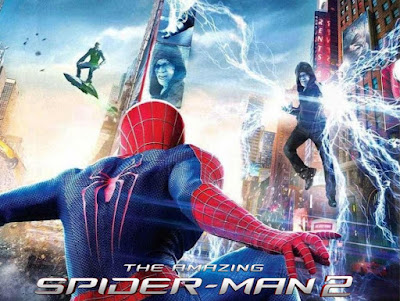
THE AMAZING SPIDER-MAN 2 (2014)


PHENOMENALITY: *marvelous*
MYTHICITY: *fair*
FRYEAN MYTHOS: *adventure*
CAMPBELLIAN FUNCTION: *cosmological, psychological*


In comparison to the relatively tight structure of the first Spider-flick starring Andrew Garfield, Number 2 makes some of the same "sophomore sequel" errors that have haunted superhero cinema since BATMAN RETURNS in 1992. One theory is that Sony was trying a little too hard to monetize the Spider-Man franchise by spinning off a franchise composed of multiple Spidey-villains, code-named "The Sinister Six" after a short-lived comics-story on a similar theme. With the recent success of the Sony/MCU collaboration on SPIDER-MAN: NO WAY HOME, Sony has started to make noises about another Sinister Six outing-- though I'm dubious as to how interesting these villains would prove without the hero himself in attendance. 

I won't quite say that the script-- all by new writers, except for some input from James Vanderbilt-- completely neglects the main character. Peter Parker (Garfield) still has numerous romantic woes with Gwen Stacy (Emma Stone). The first problem is that at the end of the first film, the hero promised Gwen's dying father that Parker would forego seeing Gwen to spare her any danger. But even though Parker has a few upsetting visions of being psychologically "haunted" by the image of Captain Stacy, the romance of Peter and Gwen can't be restrained by a commonplace superego-conflict. Since this problem gets too easily solved, Gwen is also presented with the promise of a new job if she leaves New York-- but a more tragic denouement, roughly lifted from a famous comics-story, will doom this Parker's first love-affair. Aunt May (Sally Field), having lost Uncle Ben in the first film, doesn't get any major arcs here, and J. Jonah Jameson is mentioned but never seen. But the earlier movie's allusions to Norman Osborn, mostly by mentioning his research company "Oscorp," bear fruit. 

Possibly in an attempt to distance this series from the Sam Raimi trilogy, Norman himself is first seen as a dying old man who never even comes close to becoming the Green Goblin. But SPIDER 2 also introduces Norman's son Harry, and he's rather quickly turned given an arc-- also one involving a fatal illness-- that will culminate in him becoming this universe's first goblin-themed nemesis. But far more time is devoted to Max Dillon, a nerdy engineer who works at Oscorp, who idolizes Spider-Man, but who soon becomes a new wall-crawler foe when an accident transforms him into Electro. 

The changes to Electro's background aren't objectionable, since the original comics-character was always something of a blank slate. Jamie Foxx does a decent job of capturing the electrical menace's shifts of emotion, but there's really not much to distinguish Electro from a million other movie-monsters moaning about their tragic transformations. More tellingly, the plotline involving Harry is rushed, forcing Garfield and Dane DeHaan to attempt selling the audience on their deep friendship with only a handful of scenes. The script's determination to shoehorn other villains as a prelude to a "Sinister Six" concept gets even worse at the climax, wherein Spidey fights a goofy version of The Rhino and a mystery villain is seen bringing together artificial weapons that would have been used for new versions of The Vulture and Doctor Octopus. 

Though I enjoyed NO WAY HOME's use of a "Sinister Five" (not including a cameo of Venom), I'm not sanguine about Sony seeking to expand the Spider-villains into their own franchise. The one thing I regret about the termination of the Garfield series is that both of the films had one fresh concept: to expand on the history of Peter Parker's deceased parents. In the comic books, Parker was so focused on his ties to his parental substitutes Aunt May and Uncle Ben that Stan Lee didn't bother saying much of anything about the actual Peter-parents for the first five years of the hero's existence. That led to one comics-story in 1968, and thereafter the Parkers went back into obscurity. But the writers of the Garfield films attempted to implicate the Peter-parents in the research that gave rise to the creation of Spider-Man-- and this might have been a fruitful new path for the series to have pursued. 


DINOSAURUS! (1960)


PHENOMENALITY: *marvelous*
MYTHICITY: *poor*
FRYEAN MYTHOS: *drama*
CAMPBELLIAN FUNCTIONS: *cosmological*

Here's a pair of prehistoric perils this time.

In previous viewings, I never liked Irwin Yeaworth's DINOSAURUS, the last of his collaborations with producer Jack H. Harris, following the enjoyable BLOB and the underrated 4D MAN.  But after a recent rescreening I found that though it was far from deep in terms of presenting its cosmological theme-- the fascination with prehistoric forms of life-- it had one virtue in that it was a very active film.  Even THE BLOB, despite its classic status as a concept, tends to "drag" somewhat.  But in DINOSAURUS, something's always happening.

By accident or design, Harris and Yeaworth managed to aim their three collaborations at each of three perceived filmgoer-markets.  THE BLOB, with its misunderstood teenagers, is aimed at the burgeoning teen audience of the period.  4D MAN, a more mature storyline, might not have appealed to any adults but those with a jones for SF, but the story still has an adult focus.  And DINOSAURUS spends most of its narrative time with Julio, the Caribbean island kid who gets to pal around with a dinosaur and a caveman for a little while-- surely the dream of dino-loving kids everywhere.

The adults in DINOSAURUS, mostly associated with a construction crew that accidentally unearths a brontosaurus and a tyrannosaurus, are perfuctory characters, treated with a child's idea of good and bad. This is particularly true of the cruel character of island manager Mike Hacker, who butts heads with the more charitable lead hero Bart Thompson.  A chance bolt of lightning revives the two dinos from their suspended animation and they begin roaming the island, causing trouble for the adults but fun for Julio, who gets to ride the bronto's back.  In addition, though it's not clear if lightning has anything to do with it, a caveman also awakes from suspended animation and eventually befriends Julio.

One likeable aspect of DINOSAURUS is that although Julio has fun with his new prehistoric friends-- particularly in a scene where he tries to teach the caveman to eat with utensils-- the film doesn't shy away from reminding one that real prehistoric life was nasty, brutish, and short.  This becomes readily clear late in the film, when the T-Rex finally stalks and destroys the bronto.  Hacker, the human equivalent of the voracious carnivore, has less success in his attempt to corral the caveman to use as a sideshow attraction (the usual KING KONG motif).  Eventually heroic Thompson manages to vanquish the T-Rex with the help of a steam shovel, making for a better than average climax.

The caveman, despite being played for a good deal of humor, emerges with a fair amount of pathos when he sacrifices his life for his modern-day friends.  DINOSAURUS even allows for a mild allusion to sex when the caveman gets ahold of lead female Betty.  It would be a dim kid indeed who didn't see what was on Caveguy's mind, though she manages to divert him nicely.

NOAH (2014)


PHENOMENALITY: *marvelous*
MYTHICITY: *good*
FRYEAN MYTHOS: *drama *
CAMPBELLIAN FUNCTION: *cosmological, metaphysical*


NOAH may not be the strangest religion-based film of all time, but it may well take the honor of "strangest film directly based on a canonical book of the Christian Bible." Even Robert Aldrich's subtly ironic 1962 work SODOM AND GOMORRAH pales by comparison.

That said, the script by Ari Handel and director Darren Aronofsky may be based in the story in the Old Testament, but it's clear from early scenes that the writers are only loosely adapting the Biblical story.  In the tradition of revenge-stories of all ages, this Noah is placed in the position of young Bruce Wayne, helpless to do anything when his father, the patriarch Lamech, is murdered by Tubal-Cain, a descendant of the original Cain.  But this is not pure melodrama. To their credit Handel and Aronofsky have sought to situate the conflict between Noah and his father's killer-- who will meet again when both are older men, and the world is about to be destroyed by flood-- in mythic terms relating to man's creation. Prior to the scenes of Lamech's murder, the film recites the familiar story of how Adam and Eve were beguiled by the Serpent and expelled from the Garden.  Most will be familiar with the next major event, in which Cain murders his brother Abel, but Aronofsky grounds this event in a context parallel to that of the Old Testament: that of familial descent. The third son of Adam and Eve, one Seth, in essence takes the place of the murdered Abel, so that two lines of patriarchal descent are responsible for the human race that follows-- lines which in some ways mirror one another:

six of the names in Cain's family in Gen. 4 are very similar or identical to six of the names in Seth's family in Gen. 5.  In Cain's family, we find the names of Cain (Kayin), Enoch (Chanok), Irad (Yirad), Mehujael (Mechuyael), Methusael (Methushael), and Lamech (Lemek)  In Seth's family, we find Cainan (Kenan), Mahalaleel (Mahalal'el), Jared (Yered), Enoch (Chanok), Methuselah (Methushelach), and Lamech (Lemek). --CAIN AND HIS FAMILY, Jared L. Olar.

Aronofsky's script then expands upon this conceit of rival families in a way no Noah-adaptation ever did before.  In the film the offspring of Seth, though mortal and far from perfect, give rise to the righteous family of Lamech, his still-living grandfather Methuselah, his son Noah and Noah's sons. It's unclear from the film as to whether the cinematic Seth founded the sort of tribes credited to his Biblical forbear. However, Cain's descendants have definitely become the same sort of full-fledged tribe that patriarchs in the Old Testament usually produced.  The children of Cain-- including the new patriarch Tubal-Cain-- have become masters of metalworking and primitive technology.  The association of Tubal-Cain with metalworking is wholly in tune with his Biblical model, as noted here, but the script expands upon this mythic detail and makes of it the central cause of the "wickedness" for which the Creator destroys the world. The Biblical Noah story does not expatiate upon the crimes of mankind, though it seems unlikely that technological hubris was on the minds of the ancient chroniclers. What we have, rather, is a philosophical juxtaposition of two mythic figures that are relevant to modern mankind's conception of itself.

Noah is, in essence, the archaic version of an "eco-terrorist." He does not bring about the cleansing of most of the world's living beings, but as a result of his being made a party to it, he convinces himself-- apparently with no input from God on the matter-- that he knows God's purpose for the aftermath of the devastation.  The patriarch conceives the idea that God only entrusts Noah with the duty of building the Ark so that the pure and innocent animals will be spared, while he intends that humanity will die out when Noah's family perishes.  This patently reverses the sentiments expressed in Genesis 1:28 (King James version):

And God blessed them, and God said unto them, Be fruitful, and multiply, and replenish the earth, and subdue it: and have dominion over the fish of the sea, and over the fowl of the air, and over every living thing that moveth upon the earth.

The only "subduing" in this radical departure is attributed to Noah's enemy Tubal-Cain.  In keeping with the ruthless acts of his remote ancestor, Tubal-Cain is the mythic opposition to the eco-terrorist: the eco-plunderer, who thoughtlessly pillages the land and other peoples of their riches for his own benefit, and whose will to prosper is in stark contrast to Noah's will to extinguish himself.

The philosophical argument of the two patriarchs is then worked out, not by through reflection or discussion, but through Noah's status as the somewhat unwilling begetter of the next generation.  In Genesis, Noah's three sons-- Shem, Ham, and Japheth-- are the vehicles through which the world is repopulated, though just as with Cain and Seth, one never quite knows where their wives come from. The movie NOAH, however, grapples with the question of the female role in procreation more overtly, both for reasons of verisimilitude and as an exploration of Noah's animus toward human life.

Whereas the original story includes but does not name Noah's wife, NOAH bestows the name "Naameh" on the wife and also includes a new character: young Ila, an orphaned girl who has been taken into Noah's family and who has become more or less betrothed to the oldest son Shem. Noah, who has not revealed his conception of humanity's fate to any family member, allows this dalliance because Ila is known to be barren. By the same token Noah will not encourage Ham, the second-oldest, to take a wife, in part because it might result in a continuation of the race.  Youngest son Japheth is too young to feel the same mating-urges as Shem and Ham, so that he becomes for the most part irrelevant to the narrative.

The actual building of the Ark is rendered secondary to all of these tumultuous familial conflicts, though as a possible sop to the selling-point of SPFX in Hollywood films, Aronofsky includes an element found only in apocryphal Noah-stories: he has giants build the Ark. The script references the mating of mortals and angels cited in Genesis 6:1-4, but Aronofsky's giants-- who look like multi-armed, rock-bodied Transformers-- are also depicted as fallen angels, in that their essence returns to heaven when they are slain.  Their role in the story allows for some interesting moments, but their main function seems to be to beef up the spectacle in the film.

Similarly, the Ark itself and the animals it carries are also marginalized somewhat.  Most adaptations of the Noah story are replete with explanations of how Noah's family cares for the various species-pairs, but Aronofsky dispenses with this expectation through an ingenious solution: a soporific drug hurls all the animals into hibernation. This leaves the Ark free to be a battleground of family-emotions. Ham's resentment about being denied a wife leads him to bring Noah's worst enemy into the Ark, while Ila receives a boon from her adoptive grandfather Methuselah, a boon which throws Noah's carefully prepared scheme into chaos.

It's amusing to see the inspiring if sedate deluge-tale turned into a combative drama between two opposed ways of life, and surely Aronofsky and Russell Crowe have earned some distinction for producing the world's first "kickass" version of Noah. That said, the main concern is to show Noah's obsession in a new light, one in which his righteousness becomes more alienating than Tubal-Cain's unreflective but entertaining villainy. At one point the villain bites the head of one of the preserved species, dooming the creature to extinction: yet I imagine most audiences will be amused, rather than repulsed, by his selfish will to survive.

In conclusion, I have to admit that while Aronofsky's Bible-movie is far more interesting than most within this genre, I was never entirely swept away by it. NOAH fails to be more than the sum of its parts, and many sequences fail to deliver much beyond puzzlement, such as Lamech's peculiar ritual with a snake-skin, possibly the skin from the Serpent in Eden, and the concluding coda, which seeks to rationalize Noah's canonical reputation for drunkenness.  I suspect that some of these enigmatic sections were the result of a team of research assistants, sifting through myths canonical and apocryphal to find new takes on the Noah story.  Still, at a time when so many films are tedious rote assemblages of "high-concept" schticks, a few rough edges shouldn't be despised.

SAFARI DRUMS (1953)


PHENOMENALITY: *uncanny*
MYTHICITY: *poor*
FRYEAN MYTHOS: *adventure*
CAMPBELLIAN FUNCTIONS: *sociological*


Unlike BOMBA AND THE JUNGLE GIRL, SAFARI DRUMS doesn't offer any characters as interesting as Baru, but it does return to the series' vaguely pro-ecological theme.  Rich Larry Conrad, a return to the "Ugly White Explorer" theme that launched the series, launches a safari into Commissioner Barnes' territory hoping to film exotic (read: violent) encounters with the local wildlife, for sale back in the States.  Barnes doesn't expect that Bomba will be sympathetic to Conrad and his party-- one of whom is young female assistant Peg-- but he sends a drum-message to Bomba anyway.  Bomba sends one back, essentially saying 'no."  Despite the prominence of "drums" in the title, they never play any role in the story greater than providing an exotic communication-system.


Conrad's party sets out without Bomba's guide-services, but two secrets accompany the safari.  After their departure Barnes learns one secret from local authorities, who tell Barnes that an unidentified murderer has apparently joined the safari.  This motivates Barnes to send a new message to Bomba, asking him to pose as the safari's guide and keep them busy until the local constabulary can overtake the caravan.  Bomba does so, and even uses his talent at calling animals to give the photographers more exotic subjects-- though with the stipulation that they can't needlessly shoot any of them.  When a trigger-happy fellow named Brad does shoot a lion, pretending to do so in self-defense, it's almost a given that he's going to be the killer.

Peg befriends Bomba and soon reveals the group's other secret: in one of the party's trucks Conrad's brought along a caged tiger.  Conrad plans to trap a lion and force it to fight the tiger in order to get exciting footage for the American audience.  Bomba refuses to help and deserts Conrad, yet tries to stay close to trap the killer and prevent the fight.  He's successful in the first respect but not in the last.  Apparently Monogram had access to some other film that staged a lion-tiger fight, and director Ford Beebe edited those scenes into this film, thus giving the audience the very sight that the script finds immoral.

The end is rather amusing.  Conrad, sheepish at having brought a killer along, confronts the local authorities, afraid that they might take his film away.  The colonials admit that there's no actual law against filming a lion-tiger fight-- not least because there are no tigers in Africa-- and permit him to keep his film.  However, Bomba's chimp friend Kimba intervenes with vigilante justice, exposing Conrad's film to sunlight and ruining Conrad's photographic epic.  The series doesn't always manage to dole out justice to its Ugly White (but non-criminal) Explorers, but SAFARI makes a happy exception.

DOUBLE DRAGON (1994)


PHENOMENALITY: *marvelous*
MYTHICITY: *poor*
FRYEAN MYTHOS: *adventure*
CAMPBELLIAN FUNCTIONS: *sociological*


DOUBLE DRAGON, the 1994 film adaptation of the popular 1980s video game, was a film I liked purely as I would enjoy a wildly-painted roller-coaster ride. Indeed, the film is so much like a real roller coaster that I'd be surprised if there's a solid twenty minutes when two or more characters aren't screaming "Whooaahh" at the screen (which action is almost the very last thing seen in the flick).

DRAGON focuses on two brothers, Jimmy and Billy Lee, who possess one half of a medallion which, unbeknownst to them, possesses fabulous magical powers. The other half is owned by megalomaniac Kogo Shuko (Robert Patrick, sporting hair that looks like silver Brillo), and he wants the full medallion so that he can conquer the futuristic (2007) civilization of New Angeles. He and his bizarrely-garbed gang of crazies come after the Lees and their few allies, including their sensei Julia Nickson and their impish tough-girl buddy Alyssa Milano. Lots of fight-scenes, largely silly in tone in deference to the PG rating, ensue.

There's nothing clever about DOUBLE DRAGON, whose four writers include Paul 'BATMAN' Dini and Michael 'SHOOT-EM-UP' Davis. The flick pretty much borrows its chaotic futureworld from better films like ROBOCOP and THE WANDERERS, and its one sociological underpinning (Patrick as your basic "grab it all" tycoon-villain) is bare of subtext. It's also a film where death really has no dominion. Nickson's character dies offcamera in an early scene, but though she stays dead her spirit shows up, Obi-Wan style, to cheer the heroes on at the climax. Over halfway through the picture, some writer must've thought the Lees needed some extra motivation to hate Shuko beyond his having killed their sensei, so Shuko offhandedly reveals that he killed their father as well. But though it's mentioned once or twice afterward, no one takes the matter very seriously.

Three elements caused me to enjoy this film despite its lame "we know it's all a big joke" atmosphere. First comes the costume designs of one Fiona Spence (no relation to an actress of the same name), which supply lots of pleasing eye-candy. Second, occasionally a few of the scenarios are a little funny, and I find myself wondering which if any flowed from the efforts of Michael Davis, whose SHOOT-EM-UP is replete with dozens of adventure-tropes-turned-into-cartoons. Third, Robert Patrick seems to have loads of fun with his comic-menacing villain, without ever breaking character. Patrick's Shuko is so ironically self-involved that I could imagine Robert Downey Jr. referencing Patrick's performance for the role of IRON MAN's Tony Stark.

I will note that I probably wouldn't have liked it this much had I paid money to see it in a movie theater.

SHAOLIN INVINCIBLES (1977)


PHENOMENALITY: *marvelous*
MYTHICITY: *poor*
FRYEAN MYTHOS: *adventure*
CAMPBELLIAN FUNCTION: *cosmological, psychological*


Within the corpus of kung-fu fans who love their chosen genre at its nuttiest, SHAOLIN INVINCIBLES is best known as "the one where the hot girls fight the gorillas." Being of that elect group myself, I'll happily admit that the "girls vs. gorillas" scenes are indeed the movie's highlight. However, from the standpoint of determining the film's phenomenality, the gorillas, like all the other uncanny elements, play second fiddle to one marvelous lunatic conceit: that the unnamed masters of the gorillas can "give tongue" like nobody's business.

I've used the term "uncanny" for a lot of bizarre body-effects in martial arts films because I felt that the core idea of these effects was that of bending, rather than breaking, the laws of causality. So I've stated that when martial artists "harden" their bodies to be immune to blows, that's "bending" rather than "breaking." I even made the same determination for a warrior who could stretch his limbs a few feet, in MASTER OF THE FLYING GUILLOTINE. But hey, if you can stretch your damn tongue several feet out of your mouth, you're not just a martial artist with some extraordinary body-extension ability-- you're a bloody demon, or the offspring of one. INVINCIBLES never offers one word of explanation for these glossal abnormalities, probably because some FX-guy thought it up and the writers just quick-worked it into the script.

The conflict is straightforward so as to not get in the way of the fights and effects: a tyrannical emperor has a whole family killed for a minor offense. A kindly Shaolin priest saves two girls from that family, Lu Sziu (Chia Ling) and Lu Yu (Lung Chung-erh), and raises them to avenge their families with their kung-fu skills and their swordsmanship. (So, not one of the more peace-minded Shaolin priests.) The sisters separate for a bit and kill a few of the Emperor's minions, which serves to put the villain on his guard so that he can start sending killers after them. Then the girls get back together, and for some unknown reason, one of them starts dressing like a man for a while. On top of that, the obliging Shaolin priest sends two other kung-fu warriors (Carter Wong, Dorian Tan) to help the ladies out. This naturally makes for a very episodic flick, but INVINCIBLES succeeds more than many similar films at capturing the "anything goes" vibe.


Aside from the tongue-trainers and their gorillas-- who not only fight with kung fu but also can resist sword-blades-- other menaces include a castle with traps like poison gas and flamethrowers, a guy who fights with a gourd-on-a-chain (which can also snare a sword-blade), and a fighter in a fright-mask who reveals himself as a traitor to the girls' vengeance-quest. I've graded the mythicity as poor but it's still great fun, and both Chia Ling and Lung Chung-erh look great, though Chia's character gets more attention. (They meet a peasant on the road, and he raves about Lu Sziu while saying nothing about Sister #2.) 


HONOR ROLL #140, AUGUST 6

"My name is Tan, DORIAN TAN-- at least sometimes-- but I'm still a minor character in a Chia Ling movie."


SCOTT WOLF got his one shot at celebrity playing the Brother to Mark Dacascos in this future-kicking opus.


"Boom-boom-boom," say the drums, "whenever BARBARA BESTAR walks down the jungle path."


As Noah RUSSELL CROWE had a crossover of Biblical proportions when he fought an ark-etypal battle with Tubal Cain.


He only gets his name used once in the movie proper, but DINOSAURUS makes the most of it.


JAMIE FOXX starred in "Amazing Spider-Man 2: Electro Boogaloo."