GREEN LANTERN: MANHUNTER MENACE (2012-13)


PHENOMENALITY: *marvelous*
MYTHICITY: *good*
FRYEAN MYTHOS: *adventure*
CAMPBELLIAN FUNCTION: *cosmological, sociological*


I mentioned in my review of the first half of this one-season animated series that the producers might have bifurcated the 26-episode series into two distinct (albeit interdependent) story-arcs largely to facillitate DVD packaging of the series. But this division proves valuable to me as well. Instead of judging the series as a whole, in which case I would probably give it only a "fair" mythicity rating, here I can evaluate each story-arc independently.

The first arc of the series, in addition to introducing any new viewers to the cosmos in which the Green Lantern of Earth exists (the corps of law-enforcers to which he belongs, the Guardians who empower their mission), also concentrates on depicting the Lantern Corps' new competitors in energy-manipulation. One group, the Red Lanterns, is openly hostile to the Green space-cops, while others, of Blue and Violet persuasions, are largely benign. In the original comics from the late 2000s, nine color-coordinated power-users were finally established, and the second arc add just one more hue to the program, in the form of an Orange Lantern. But once the nasty Red villains are defeated in the first arc, the second arc begins by largely de-emphasizing the "color guard" aspect of the cosmos takes a back seat to the status of artificial intelligence in this fictive universe.

To be sure, the early introduction of the Aya character foregrounds this later development. When Hal Jordan (the Earth Green Lantern) and his alien comrade Kilowog begin their quest to thwart the Red Guys, the sentient navigational computer aboard their starship decides that she wants to emulate their heroism, and so forms her own robotic body (which Hal dubs "Aya" for "AI.") When this three-person ensemble expands to include Razer, a remorseful Red Lantern, the two new kids on the block evince muted romantic feelings for one another-- thus setting up one of the main story-threads of Arc II.

In place of the first arc's employment  of multi-hued ring-wielders, MANHUNTER MENACE dovetails two separate opponents from DC comics serials, linked only by some association with the Guardians of the Universe. The titular Manhunters follow the basic rudiments of their comics-counterparts. All are super-advanced robots invented by the Guardians to serve as an intergalactic police force, only to be mothballed when the Guardians realized that the Manhunters, lacking emotion, could not execute an even-handed justice. The second opponent, the Anti-Monitor, was in the comics an extra-dimensional being devoted to the idea of exterminating all life. His signature appearance was in 1986's CRISIS ON INFINITE EARTHS, wherein his existence is loosely linked to an even earlier act of hubris by one particular Guardian, name of  Krona. This Guardian is obsessed with learning the forbidden origins of the universe, as elaborated in the 1965 Green Lantern tale SECRET ORIGIN OF THE GUARDIANS. In MANHUNTER MENACE, Krona is briefly referenced, but his hubris is confined to creating yet another super-robot, the Anti-Monitor, which immediately dedicates its existence to wiping out organic life. Episode 14 of the GL series establishes that the Anti-Monitor, for a time banished to another dimension, has returned to Hal Jordan's cosmos and has enlisted the Manhunter hordes as its agents.

Though I felt rather iffy about the series duplicating the Frankensteinian motif for both the Anti-Monitor and the Manhunters, the writers managed to sell it by relating their mechanical opposition to life to Aya's forlorn struggle to attain humanity. When Aya expresses love for Razer and is rejected-- largely because Razer is a widower and doesn't feel capable of loving again, much less loving an artificial being-- she ends up becoming bonded with the Anti-Monitor. Thus the super-robot's quest to extirpate inefficient biological life becomes Aya's drive to eliminate the painful sphere of human emotions from existence-- even to the extent of rewriting "the Big Bang," using imagery patently copied from the above SECRET ORIGIN comics-tale.

Like the previous arc, MENACE intersperses its long-range plot with short, more-or-less self-contained stories. These are usually no better than fair, even when they introduce plot-threads important to later stories. (For instance, in "Blue Hope" Razer attempts to assimilate the disciplines of the Blue Lanterns to sublimate his ferocious emotions, and this gives him a technique he uses to good effect in the next to last episode.) Most of the standalones seem oriented toward introducing other characters from the comic book mythos for possible later use had the series lasted longer, including not only the aforementioned Orange Lantern but also versions of Sinestro and Guy Gardner. Carol Ferris makes her only appearance in this arc in "Love is a Battlefield," but though she once more transforms into the show's version of the comics-character Star Sapphire, her character in both of her identities proves underwhelming.

Nevertheless, the master story-thread of Aya's status as a AI looking for love, and rediscovering both her true nature and her inner potential in the final episodes of the arc, and so, even without the chance to further develop this cosmos, it still ends on a high note, and may be the best thing to have come out of the misfire of the 2011 live-action film.

RESIDENT EVIL: RETRIBUTION (2012)


PHENOMENALITY: *marvelous*
MYTHICITY: *fair*
FRYEAN MYTHOS: *adventure*
CAMPBELLIAN FUNCTIONS: *sociological*

I have to say that RETRIBUTION-- the latest live-action film in the franchise, all of which have starred Milla Jovavich as the heroine Alice-- was the weakest one I've seen in terms of action and spectacle.  Part of the problem is that most of the action takes place within one big complex, depriving the story of the quasi-epic scope available in other entries.  Ironically, making this film more like a video game deprives the film-franchise of one of its best features.


Alice and many familiar faces from the series-- Jill Valentine, Rain Ocampo, and Albert Wesker-- appear here, but the script, as marking time for the proposed "sixth and final installment," does little more than put them through some "Alice in Wonderland" mutations.  Alice's ally Jill turns against Alice, having fallen under the power of the human-hating computer program "the Red Queen." Alice finds that she herself has been cloned, and that one of her clones has produced a female child, one Becky, who happens to be deaf-and-dumb.  Wesker, usually a villain in most of the stories, enlists Alice and her friends to help him prevent the extinction of humanity by the killer zombies.  None of it is precisely bad, but none of it has the extra *oomph* that made other series-entries fairly appealing.  The most I can say is that RETRIBUTION includes a very good hand-to-hand battle between Jovavich's Alice and Sienna Guillory's Jill.

In contrast, the animated film DAMNATION-- the second film of its kind, and released in the U.S. slightly after RETRIBUTION-- manages to keep some of that old kickass feel. Again, since I don't follow the games, perhaps I enjoyed DAMNATION better simply because it was my introduction to two new characters, American soldier Leon S. Kennedy and devious spy-girl Ada Wong.  Wong actually shows up in RETRIBUTION as well, but her character in the live-action movie lacks the gusto of the animated version.  In addition, DAMNATION, in addition to the usual slobbering alien-predator mutant monsters, benefits from a strong villain, lady president Svetlana Belikova of the "Eastern Slav Republic."

I can't say that either film's plot stuck with me very long, but DAMNATION scored with me by creating some incidental characters-- albeit characters doomed to perish almost immediately-- a small band of Slav rebels attempting to fight Belikova but also attracted to American pop culture.  In contrast, RETRIBUTION was just the same old group of recurring characters, and so proved a little on the boring side.  Possibly Paul Anderson took it easy with this one while warming up for his supposed big finale.

SPACEHUNTER (1983)


PHENOMENALITY: *marvelous*

MYTHICITY: *poor*
FRYEAN MYTHOS: *adventure*

CAMPBELLIAN FUNCTION: *sociological, cosmological, psychological*

The same year's SPACEHUNTER shows off better acting and better production values, but though it too has a hero and his aides running around a planet with a fuzzy goal, it's not as much fun.


Three beautiful survivors from a destroyed space cruiser are cast away upon a failed colony world plagued by disease.  They're promptly taken prisoner by the risibly named "Overdog," (Michael Ironside) who rules with an iron hand-- or rather, a pair of iron claws built into his cyborg body.  Overdog's act provides a reason for authorities to send a mercenary in quest of the women, though they themselves are never important characters.

Peter Strauss plays a raffish "lone wolf" hero, appropriately named "Wolff," a bargain-basement Han Solo type.  He and his robot partner (Andrea Marcovicci) descend to the planet and promptly get into a firefight with some scruffy locals.  The robot is destroyed, but Wolff stays on the trail.

He doesn't get to remain alone for long.  A packrat-looking young girl named Niki (Molly Ringwald, several years away from being a star) tries to steal his transportation, but despite this "meet-aggravating" he consents to let her be his guide on the hostile world.  Shortly after this encounter, Wolff is attacked by an old competitor, Washington (Ernie Hudson), who's also planning to liberate the women for a reward.  Wolff knocks his rival around and steals his transportation.

Niki doesn't prove to be much of a guide, as twice she fails to lead Wolff clear of dangers, including mutant baby-creatures and a race of lake-dwelling Amazons.  Finally the two of them encounter Washington again and Wolff is forced to make a deal to split the reward to get the other mercenary's help. 

The two mercs penetrate the fortress of Overdog, where the cyborg holds arena-contests to find the most spirited subjects-- whom he then subjects to a machine that drains their life force into him.  Niki also sneaks into the fortress without Wolff's knowledge and ends up running a gauntlet of dangers in the arena.  Her reward for this is to have her life-force tapped by Overdog, who explains that he needs her youth because "I'm very old."  That probably wasn't the first time she heard that line.


Wolff and Washington succeed in taking down Overdog with a big explosion, and the three heroes escape with their prizes.  The action is decent if a little predictable, though certainly better than one might expect from Lamont "LIPSTICK" Johnson.  I liked the designs of the weird alien vehicles, but the cyborg-costume of Overdog isn't much to speak of.

Possibly the best aspect of SPACEHUNTER is the ersatz "father-daughter" vibe that grows between Wolff and Niki, best illustrated by a scene in which he gives her a bath because he's sick of looking at a dirty urchin.  It sounds like the sort of scene that could become creepy, but Johnson does keep it clean, and even makes the scene faintly amusing.

THE MAGIC SWORD (1962)


PHENOMENALITY: *marvelous*
MYTHICITY: *poor*
FRYEAN MYTHOS: *adventure*
CAMPBELLIAN FUNCTIONS: *metaphysical*


Up for consideration this time are works associated with two of the most important names in 1950's metaphenomenal cinema: writer/director/producer Bert I. Gordon and writer/director Jack Arnold.  In the latter case Arnold functions largely as a "hired gun," but in the former, Bert I. Gordon was fully in charge of 1962's THE MAGIC SWORD.  The results, unhappily, were not as some of Gordon's other films reviewed here, like THE CYCLOPS and VILLAGE OF THE GIANTS.

SWORD's script is credited to noir-film specialist Bernard Schoenfeld, whose only other metaphenomenal film was the more celebrated SPACE CHILDREN (directed, incidentally, by Jack Arnold).  SWORD has a fairly winsome setup. George (Gary Lockwood), a young would-be knight, is born to a noble family but is raised to manhood by benign witch Sybill (Estelle Winwood).  He wishes to rescue Princess Helene, his "love at first sight," from the evil wizard Lodac (Basil Rathbone).  Lodac's motives are a little more familial than most evil wizards; he wants to feed Helene to a dragon because the king of the land burned his sister when she was the same age as Helene-- implicitly because Lodac's sister was genuinely guilty of witchcraft, though no one dwells on this point.  We later learn that Lodac has been feeding other maidens to his dragon, so Schoenfeld may have been aware of the sacrificial aspects of maiden-and-dragon myths in general, and of the St. George legend specifically-- on which SWORD is very nominally based.

Lodac has an ally in court: the nasty Sir Branton.  Branton has custody of a magic ring which Lodac desires, so the magician agrees to let Branton rescue Helene in exchange for the ring, so that Branton will then receive both Helene and the usual reward of half of her father's kingdom.  Branton's plan is complicated when George shows up to join the rescue party, along with six other noble knights, who were frozen in Sybil's cave and whom George thawed out to serve as his retinue.  Lodac unleashes seven curses to kill off the seven unwanted knights before they can reach the wizard's castle.  One by one George's brother-knights-- who are from nations other than George's English locale-- are killed off by such curses as a giant ogre, a quicksand pit, and a woman whose beauty is the disguise for an ugly hag (Maila Nurmi, aka "Vampira").  One of the oddest deaths is that of the Irish knight Patrick, who even in dying saves George by what Lodac describes as "the power of his faith"-- the only overt Christian reference in the film, and one I found jarring amid all the wild fantasy.

Naturally George makes it to the wizard's castle, though thanks to the meddling of his foster mother he loses his magical weapons and is captured by Lodac.  This misfortune gives Helene the chance to reciprocate his love before she's lined up to be the dragon's next meal.  Sybill redeems herself in helping George re-arm himself to fight the dragon and for good measure finishes off Lodac as well.  The happy ending is so happy that by some unspecified grace the six slain knights are all brought back to life.

SWORD's simple FX, mostly supplied by makeup or puppetry, were nothing that would given Ray Harryhausen any sleepless nights.  I remember vaguely liking SWORD when I saw it at some young age, but while I can easily imagine its FX being charming or frightening to persons in the right mood, I don't think I got much out of them back then, and they didn't do much for me now.  All things considered, despite some pleasing moments-- mostly those involving Winwood's dotty witch-- Schoenfeld's script lacks the heart of the better Harryhausen productions, or for that matter Gordon's previous kid-film outing, the far superior BOY AND THE PIRATES (1960).

CAPTAIN CLEGG (1962)


PHENOMENALITY: *uncanny*
MYTHICITY: *fair*
FRYEAN MYTHOS: *adventure*
CAMPBELLIAN FUNCTIONS: *sociological*


Since writing these two reviews, I've still not read any of the original Russell Thorndyke novels about the early quasi-superhero "The Scarecrow," a.k.a. "Doctor Syn." The character-- a former pirate named Clegg, who escaped his alleged death and became a parson in a small English village-- might be closer to a "villain" than a "hero," albeit a very benign villain. In the same way that Robin Hood fought the soldiers of the king to benefit the poor, Syn-- who is renamed Doctor Blyss in the 1962 film-- is out to better the lives of Romney Marsh's citizens by helping them smuggle wares in and out of the country. The local lawmen don't like this, just as the soldiers of King John resented Robin Hood's incursions, and on this hinges the conflict-- though Clegg/Blyss adds one touch that the lord of Locksley never thought of; having his merry men dress up in phosphorescent ghost-costumes to scare off the curious. However, one other major difference is that Robin Hood's opposition to the legal authorities comes to an end when King Richard returns and kicks John out. Within the context of the Thorndyke setup, smuggling will always be illegal, and so Blyss can only keep fighting the law until it kills him-- which, to drop a very minor spoiler, is exactly what transpires.

Since the plot-action of CLEGG is pretty close from that of the 1937 DOCTOR SYN, I won't repeat the specifics of the plot. Suffice to say that a new officer comes to Romney Marsh with the intent of rooting any and all smugglers. No one in 1962 or since is likely to doubt that the serene-looking parson Blyss (Peter Cushing) is really behind all the skullduggery, nor that the two young lovers Harry and Imogene (Oliver Reed, Yvonne Romain) are destined to come together despite all odds. In one way Hammer's version is racier than that the 1937 adaptation: in both films an older man, who has functioned as a not-very-paternal guardian to Imogene since her childhood, puts the moves on his ward, revealing her tainted past so that she'll marry him. But the Hammer film plays the scene with more attempted bodice-ripping.

In terms of acting, Peter Cushing could do this simple swashbuckling-role in his sleep. The best scenes involve the limber actor showing off his fighting-skills against a bulkier opponent, and later trying to escape the constables at the film's finish. The film's visuals are both stark and evocative, particularly in the scenes with the "phantom horsemen." CLEGG is certainly the most watchable of the three adaptations.

GHOULIES IV (1994)


PHENOMENALITY: *marvelous*
MYTHICITY: *poor*
FRYEAN MYTHOS: *comedy*
CAMPBELLIAN FUNCTION: *metaphysical, psychological*


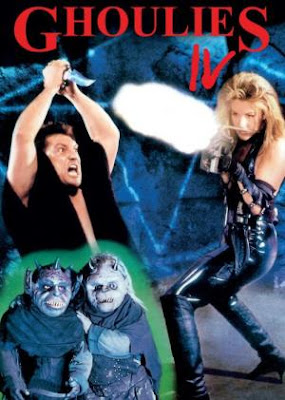
GHOULIES IV, the last in the series, remains in the same comedy-mythos as the third flick. Yet strangely, director Jim Wynorski and writer Mark Sevi mold the flick to resemble the first film in many respects, which as I said in my review had largely borrowed its plot from Lovecraft's THE CASE OF CHARLES DEXTER WARD. This partial fidelity may come from Sevi, who from the years 1992 to 1995 worked on SEVEN sequel-flicks in addition to this one.

I argued that the first GHOULIES emphasized the magician (Michael Des Barres) who summoned the titular demons as part of a plan to possess his grown son (Peter Liapis) for a power-enhancing ritual. The daddy-magician is never directly referenced, though a couple of archival shots of the Des Barres character are included, and the specific circumstances of the Liapis character, Jonathan Graves, are altered in many respects. Thus the guy who almost got possessed by the spirit of his dead father is now a guy who mucked around with occultism in earlier years, partly because both he and his then-girlfriend Alexandra (Stacie Randall) were both into it. But in a barely coherent backstory, somehow they unleash an evil version of Jonathan from the same other-dimension where the Ghoulies live. Alexandra likes Evil Jonathan better, has sex with the evil double, and then is sent to an asylum when she tries to kill Good Jonathan.

All this is revealed toward the end, as if Sevi didn't really want to bother with such details. When the film opens, Alexandra, dressed in sexy bondage-wear, has escaped the asylum and is seeking to make possible the rebirth of Evil Jonathan, who for some vague reason has taken the classical name "Faust." (A subliminal reference to "the Great Fausto" in GHOULIES II, maybe?) In order to revive Faust, Alexandra sacrifices a bunch of innocent victims, but she can only bring Faust into the human world with the help of an amulet, the Jewel of Knowledge. She tries to do so, and bungles the ritual, losing the amulet and also bringing two benign Ghoulies into her world. The two demons, this time played by little people actors, just want to go home, and they go looking for Jonathan for help.

Jonathan by this time has hung up his horned hat for a badge. He's also much more of a stud than the first version, for he's broken up with hot policewoman Kate (Barbara Alyn Woods), who is now his superior on the force, and he currently dates a hot prostitute. While investigating the recent deaths, he stumbles across Alexandra but doesn't immediately reveal that she's an asylum escapee. He and Kate argue about procedure while Jonathan investigates the murders on his own. Alexandra ambushes Jonathan with a mesmerized cop, and Jonathan reveals that he hasn't forgotten his occult past, since he shoots rays from his fingers and banishes the possessed cop to the otherworld.

There's a lot of aimless episodic stuff that happens before Jonathan somehow intuits that Alexandra, having recovered the amulet, is going back to her old asylum to perform a ritual for summoning Faust, Kate, still in love with Jonathan, follows. Jonathan and Kate dole out some good fisticuffs, but Alexandra still manages to allow Faust to possess Jonathan's body. Oh, and the Ghoulies putz around for a while before making a slight contribution to the happy ending. There's also a sequel hook at the very end, which happily did not lead to any more entries. 

The script is without doubt cheesy, but thanks to the pulchritude, the fight-scenes and a (very few) funny lines, it's more palatable cheese than GHOULIES III. My only other observation is that whereas Jonathan Graves got sidelined to the evil magician in the first movie, this time he's the main character, inconsistent as he is.


HONOR ROLL #109, MARCH 8

 She's not the star of GHOULIES IV, but who remembers the main character when STACIE RANDALL is onscreen?


Not yet a star, OLIVER REED played a stooge to yet another version of the swashbuckling smuggler CAPTAIN CLEGG.


"If you believe in magic..." you still might not want to believe in BASIL RATHBONE.


MOLLY RINGWALD was only "the girl" in SPACEHUNTER, but she would soon leave star Peter Strauss in her dust.


MICHELLE RODRIGUEZ returns to kick Alice's butt back to Wonderland.


RAZER's chances for love, appropriately, were only "razor thin."