TEEN TITANS SEASON FIVE (2005-06)


PHENOMENALITY: *marvelous*
MYTHICITY: *fair*
FRYEAN MYTHOS: *adventure*
CAMPBELLIAN FUNCTION: *cosmological, psychological*  

                                                                                                              The final season of TEEN TITANS provides an overarching plotline concerning Beast Boy's first superhero team The Doom Patrol, though said group wasn't mentioned in any previous TV-episodes. In comic books, DC debuted both TEEN TITANS and DOOM PATROL within a few years of one another, and though they were largely independent, Beast Boy of PATROL guest-starred in one issue of TITANS-- which later resulted in the shapeshifter becoming a New Teen Titan in the 1980s.  The 1980s comic also concluded a hanging plot-thread left over since PATROL's cancellation in the 1960s, and this storyline resulted in the Patrol's old foes, the Brotherhood of Evil, becoming members of the New Titans' regular rogues' gallery.                                                                                            
 
                                                                                                                                                                                                                POOR

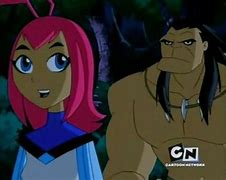
Only one episode this time is a waste of time. The Titans pursue their recurring villain Doctor Light into a subterranean domain where prehistoric life has persisted. It's too complicated to go into the comics-histories of the two quasi-heroic locals, Gnarrk and Kole, but as far as I've concerned, both were boring in the comics and the TITANS writers aren't able to make them any less so. I suppose the eating contest between Gnarrk and Cyborg is moderately amusing.                                                                            

 FAIR 
                                                                                                    
GO! -- This episode, whose title is a patent reference to the catchphrase "Teen Titans Go," is the only fair-mythicity episode which isn't tied into the overarching "Brotherhood of Evil" plotline. The episode is a very condensed version of the origin of the 1980s Titans, in which Starfire escapes her captors, the extraterrestrial marauders called Gordanians. Various contrivances cause Robin, Raven, Cyborg and Beast Boy to oppose the Gordanians' attempts to recapture Starfire. The story naturally emphasizes action more than character explication. But some strong moments include Beast Boy's first meeting with Robin, acting the fanboy to the Teen Wonder. Starfire appears as the product of a ruthless warlord culture, so the episode's not able to explain how she transitioned to the "puppies and kittens" Starfire of the later episodes.                                                                                                                            

HOMECOMING PTS 1-2, TRUST, FOR REAL, SNOWBLIND, HIDE AND SEEK, LIGHTSPEED, CALLING ALL TITANS, and TITANS TOGETHER-- All of these episodes are organized around the resurgence of the Brotherhood of Evil. This villain-team's core members are The Brain, the intelligent gorilla Monsieur Mallah, General Immortus, and the rubber-limbed Madame Rouge, though by the last episodes they've managed to enlist nearly all of the Titans' recurring enemies in their project to "destroy all Titans."              HOMECOMING chronicles Beast Boy's first encounter with the Patrol since he resigned from their ranks, which include Robotman, Negative Man, Elasti-Girl and Mento, the latter serving as the team's leader. All four are under-characterized, probably because the writers knew that they weren't to make more than token appearances. Beast Boy's reasons for leaving that group aren't articulated, but it's likely that he rebelled against Mento's severe and unforgiving attitude. In fact, all four Patrollers are bereft of any humor or fellow-feeling, and the HOMECOMING script treats them as if they were ultra-military types, focused only upon beating the enemy. This is more than a little ironic, since in the original comics from the 1960s, PATROL was distinguished by its display of rollicking humor, while the TITANS comic was usually only funny by virtue of its writer seeking to emulate the speech patterns of 1960s teenagers.                                                                                         

TRUST follows Robin as he seeks to prevent Madame Rouge from abducting Hotspot. This episode feels much like filler, given that Hotspot had only a minor appearance in WINNER TAKE ALL and certainly didn't do anything to earn himself a big fandom.          

FOR REAL-- Control Freak breaks out of jail and invades Titans Tower to challenge his old foes. Instead of his usual foes, the villain finds that the Titans East have taken up residence in the Tower while the other heroes are on missions. There are a few funny moments where Control Freak debates with other cyber-chatters as to whether he should even bother battling such rank unknowns. Of course, he does, and he even goes the "average villain" route by setting up physical challenges for the Easterners-- who naturally kick his butt just as hard as the Western branch did.         

SNOWBLIND-- This story, only tangentially related to the Brotherhood arc, involves the Titans going to Russia to fight a marauding monster. While searching for the creature, Starfire is separated from her group but finds shelter in a quarantined facility occupied by Red Star, a soldier given unstable powers in a government experiment.  There's an involved comics in-joke here, in that although Red Star did appear in the 1980s TITANS series, he was derived from a sixties character, who was the first DC character to be named-- Starfire.                                                

HIDE AND SEEK-- Raven gets her only solo comedy episode, as she's charged with protecting three grade-schoolers from being captured by the Brotherhood. The humor's very predictable, made palatable only by the characterization of Raven.      

LIGHTSPEED-- In this odd segue, loner-hero Kid Flash-- a frequent Titan in the comics but seen here for the first time-- makes life miserable for the "Hive Five." But even without the Kid's interference, the Five's leader Jinx finds herself constantly undercut by her lazy-ass comrades (now upped to six with the inclusion of Billy Numerous and two newbies, See-mour and Kid Wycked). Moreover, when Jinx tries to curry favor with the Brotherhood, she finds that they're something less than accomodating.                                                                               
CALLING ALL TITANS just sets up the action for TITANS TOGETHER, when the principal Titans invade the Brotherhood's sanctuary and free all the prisoners the villains have captured. There are various character bits that enhance TOGETHER's mythicity, but the main appeal is kinetic, as the animators unleash what may be the largest multi-character fight-scene in the history of world cartoons. This episode seems to have been conceived as a possible conclusion for the series, though one more episode was produced to give the series a more wistful send-off.                                                                                                                                                                                                                                                                                        

GOOD 
                                                                                                               REVVED UP-- In the 1960s TITANS comic, the writer introduced a villain with the improbable name of "Ding Dong Daddy," who executed crimes with the help of specially rigged vehicles. This was a rare (for the time) shout-out to a cartoon character outside the boundaries of four-color comic books: the artistic persona of Earl "Big Daddy" Roth, a caricaturist renowned for weird monsters driving fast cars. REVVED UP introduces the animated Ding Dong as a guy who somehow gets hold of a secret treasure owned by the Teen Wonder himself. When Robin and the other Titans try to reacquire the mysterious item, Ding Dong compels them to participate in a car-race-- and Cyborg, who dearly loves his T-car, is more than happy to oblige. A bunch of other villains show up to try winning Robin's mysterious prize, including Red X, the mystery thief who took over Robin's phony criminal identity-- though in some ways Red X shows some of Robin's own sense of personal honor. Ding Dong is aided by a mobile pit crew, whose monstrous servicemen look like the comical ghouls drawn by "Big Daddy," and that alone gives extra heft to the episode's mythicity.  

THINGS CHANGE-- Every other TEEN TITANS episode, no matter how good or bad in terms of symbolic discourse, is structured as formula entertainment. This observation isn't meant to have any negative connotations. It simply means that the raconteurs structured their narratives to respond to the expectations of the audience, rather than obliging the audience to follow where the storyteller wants to go. But in THINGS CHANGE, the production team concluded their series with the superhero equivalent of FALL OUT, the final episode of the 1960s teleseries THE PRISONER. Like FALL OUT, CHANGE is full of uncertainties, of questions without answers. The five Titans stride into town looking for their favorite haunts-- a pizza place, a video store-- but those touchstones have been closed down. From a construction site a metamorphic monster pops out and attacks them. While four of the heroes pursue the creature and eventually defeat it-- though they never know what it was or why it attacked-- Beast Boy is astounded to see, amid a crowd of onlookers, a dead-ringer for the deceased Terra. No other Titan sees her, nor do they join Beast Boy when he investigates the place where they enshrined Terra's body, converted into pure stone during her battle with Slade. Not only does the changeling find the statue missing, he's attacked by a being that resembles Slade, who keeps telling him to leave the young girl alone. When Beast Boy defeats Slade, Slade turns out to be a robot, but there are no clues as to who programmed the mechanical man for this exigency. As for the girl, she denies any identity with Terra but rather significantly never gives her "real" name. While she's fairly kind toward the confused young superhero, she flatly disavows any connection with the world he lives in, and the story ends with Beast Boy, committed to the life of a hero, rushing off to join his friends in their next mission and reconciling himself to his loss. Many fans didn't like this mysterioso conclusion, but I was glad to see the producers bow out on this atypical note of loss and heartache.   

ASSASSIN (1986)


PHENOMENALITY: *marvelous*
MYTHICITY: *poor*
FRYEAN MYTHOS: *adventure*
CAMPBELLIAN FUNCTION: *cosmological*

I saw a lot of the journeyman-TV work of Sandor Stern, but not much of his writing and/or directing proved memorable, and his one big break into feature films, writing the screenplay for THE AMITYVILLE HORROR, is far from one of my fave horror flicks. That said, I did at least remember this mostly routine TV-movie better than a lot of others.

It's a mark of Stern's gimcrack scripting that when retired CIA agent Henry Stanton (Robert Conrad) is persuaded to help terminate a killer who's preying on other agents, nobody thinks it necessary to impart to Henry the information that the killer is a high-functioning robot. Even the woman Henry is partnered with, a female scientist named Mary (Karen Austin), doesn't bother to explain this little detail until after Henry has had his first run-in with the super-strong automaton. Since it's a TV-film, the ballyhoo surrounding the story would have ensured that anyone watching knew the subject matter, so who was Stern trying to surprise?

That said, once that clumsy set-up is done, ASSASSIN moves briskly enough from point A to B and so on. Mary explains that the robot (Richard Young), given the ironic name of Robert Golem, was designed to function as an assassin for the CIA, but for some reason it malfunctioned and started killing off its handlers-- one of whom is Mary. In contrast to the cinematic Terminators on whom this killer robot is partly modeled, Golem is supposed to function in society like a regular human, and to that end he's been given a good-looking face and build and even instructed in how to seduce a woman if it serves his mission.           

Yet for every element Stern provided that might hold some promise, he largely botches that potential. Golem does indeed seduce a young woman to give himself some cover, but nothing much comes of this. Late in the movie, because Golem can access all CIA files, he tries to persuade Henry to desert the agency boss because the guy betrayed Henry on a previous mission. Henry is clearly irritated by the revelation but he nevertheless doubles down his efforts and does end up terminating the terminator. It might have been more interesting had Henry had some real internal debate about which villain was the greater menace.

Since Young isn't on screen enough to build up his persona, Robert Conrad is pretty much the whole show here. As Mary, Karen Austin doesn't have much to do but to provide exposition. There's one odd moment where, despite being a non-combatant, she gutpunches some enemy agent. I like to think the actress complained about having too little to do, so Stern just cobbled together a scene where she hit someone.    


TO KILL WITH INTRIGUE (1977)


PHENOMENALITY: *marvelous*
MYTHICITY: *good*
FRYEAN MYTHOS: *adventure*
CAMPBELLIAN FUNCTION: *metaphysical, sociological*


Otherwise known as JACKIE CHAN'S HAMLET! Okay, I'm the only one who calls TO KILL WITH INTRIGUE by that name but given that this obscure Taiwanese flick predates Jackie's jolly image, I could justify the name just on the basis that this has to be Chan's grimmest, most morose role up to this point in his career.

However, one of INTRIGUE's scenes made me think of the key HAMLET scene in which the hero renounces Ophelia, possibly (as some critics speculate) after he's made her pregnant. In INTRIGUE, young nobleman Shao (Chan) meets with Qian (Yu Ling-long), a maid in his father's court, and tells her to take a hike, despite knowing that she has a bun in the oven. Not too much later, he bursts into the court, telling all of the guests celebrating his father's birthday to get lost too. The guests leave, and Father Lei yells at Shao. Shao says he did it all to keep innocents out of harm's way, and he removes an item from his tunic: a dismembered hand with the image of a human-headed bee drawn upon it. Shao doesn't say how he came by this curious oracle, but he claims it's the calling-card of a gang of kung-fu bandits, the Killer Bees, whom Lord Lei attempted to wipe out. While the lord is conferring with his son, wife, and retainers about the incipient attack, four guests return to the court-- only to drop dead. A strange one-handed man shows up (maybe a cutesy reference to Jimmy Wang Yu's One-Armed Swordsman?) and demands the return of his hand. Shao flings the dead hand to the probably dead man and the latter bounds away.


Then the attack by the Killer Bees begins in earnest. Armed men appear on the estate-walls, and into the courtyard five coffins appear. The coffin lids shoot off, and up spring the assault's leader and four cohorts, all attired in flower-masks, as if seeking to conflate death and fertility. The leader is Ting Tan-yen (Hsu Feng), a beautiful woman wearing a half-mask over her lower face, and after swearing vengeance, she engages Lord Lei in sword-combat. A melee breaks out, but the Lei family is overmatched. Ting kills the hero's mother and father and easily beats down Shao's weak nobleman-fu. However, he manages to get a sword to Ting's throat. She invites Shao to kill her but only after she shows him the facial scar beneath her mask, a wound she got from Shao's father when she was still a child. Doubt, the curse of the Melancholy Dane, causes Shao to hesitate, and Ting knocks him out.

When he awakes, he sees Ting from behind and thinks it's his lost love Qian. Ting tells Shao that she spared his life so that he'd suffer as she suffered the loss of her family. Shao can do nothing but go looking for the woman he spurned, even for reasons he thought beneficent.

To be sure, Shao wasn't completely stupid about the risks of chasing off his pregnant mistress; he mentioned to his father that he sent a friend named Jin to look after Qian. Jin does show up just as bandits attack Qian, and he kicks their asses before taking Qian to his house. However, Jin doesn't seem to know why Shao disavowed his mistress. Qian wants to flee the general area and Jin obliges her, so that when Shao comes looking, no one's to home.

A disconsolate Shao stays at Jin's house. Ting shows up, twisting the knife by telling Shao his friend's gone off with his lover. Then she calls Shao a "beast," which just so happens to be what Qian called Shao when he gave her the kiss-off. Shao hallucinates that Ting is Qian, embraces her, and summarily beds her. It's not clear if Ting is aware he's mistaken her for someone else, though there's no question she could've stopped Shao if she'd wanted to. After they've had sex and Shao's passed out, he mumbles Qian's name and Ting runs off, jealous as hell. (I admit Hamlet didn't do quite this much bed-hopping, though a fellow named Freud claimed that he had a certain ambivalence about his mama.) 


Then Shao pays the price for a grudge against Jin, as three paid assassins break in on him. He fights them and he kills one, but the other two knock him out. Fourth Dragon, an older noble, shows up and tells his assassin-employees that they assaulted the wrong man. He pays them off but when they want to murder the unconscious Shao, Fourth Dragon drives them off. He has Shao brought to his home, apologizes, and tells Shao that Jin ripped off the cargo that Fourth Dragon's guard-escorts were protecting. Slightly later, Ting shows up again-- "I am your shadow," she mocks the anguished hero-- and though she won't tell Shao where Jin and Qian are, she tasks him with not even having the filial piety to bury his slain parents. Further, she says, they were buried by none other than his recent benefactor, Fourth Dragon. Shao, unable to find his lost love, sublimates his desires by pledging loyalty to a "second father," joining the Dragon's guards. Does Fourth Dragon take the place of Lord Lei, the father whose virtue became suspect? The clan of the assassins attacks the guardians, and Shao leads the fight against them, calling himself "Fifth Dragon." But the assassins really start losing when Ting Tan-yen joins the battle, without explaining why she interceded. She leaves Shao in the care of Fourth Dragon for the time being but later persuades him to let her take Shao to her own domicile. 

On top of all these sturm-and-drang incidents-- Shao finding a new father to replace the dead one, or having his life preserved by the woman who killed both parents-- Fourth Dragon meets the governor, to whom his life is forfeit for losing a precious cargo-- and it's none other than the robber Jin, who is ALSO the head of the assassin-clan. Basically, everything Jin has done has been to advance his clan's power in the region, and he even takes credit for eliminating the Lei family. This may have been an overreach on the author's part, since Jin doesn't seem affiliated with the Killer Bees, who aren't mentioned or seen again after the opening fight. Jin fights and kills both Fourth Dragon and his aide, and then proceeds to his estate, where he uses honeyed words to persuade Qian to marry him. She agrees, wanting to protect her child and grieving because she's been told Shao is dead. 


Now, thus far INTRIGUE hasn't had anything like Hamlet's ghostly father, or even the Devil whom Hamlet half-suspects of having sent the paternal apparition. However, there is a slight sense of passing into another world when Shao is taken to Ting's estate. Ting heals Shao but won't let him leave if he can't beat her in kung fu. He practices continually, but he's unable to up his game. He challenges her anyway, and she punishes him in various ways, which reminded me of the ordeals heroes would undergo from goddesses. (Admittedly the Classical deities didn't make their acolytes swallow hot coals or suffer having their faces burned). Finally, in contrast to the majority of chopsockies, Ting realizes Shao can't equal her. She feeds him a drink mixed with her own blood, and this empowers him so that he can now destroy Jin and save Qian, even though Ting's implicitly condemned to a loveless existence.

I admit that Shao's quest for vengeance isn't responsible for the deaths of almost all of the principal characters, as Hamlet's quest causes the fall of the Danish court. However, a few times the English translation criticizes Shao's inability to tell good from bad, which is closer to Hamlet than most martial-arts heroes ever come. Shao's overly trusting friendship with Jin makes it possible for the evil plotter to end the lives of the Fourth Dragon family, and (maybe indirectly) those of the Lei Family too. It is a major error when Ting's Killer Bee allies just disappear. In a plot-sense Jin's assassin cult more or less takes the place of the recrudescent bandits, even though Ting clearly does not connect the two in any way when she cuts a bloody swathe through the assassins to protect Shao. While INTRIGUE was no more than a bump in the road of Jackie Chan's ascension to international success, it does deserve to be better known as one of the few kung-fu films to possess some psychological depth. I haven't seen all the films in Hsu Feng's repertoire, but I doubt any other role she played came close to that of the tormented Ting Tan-Yen.   

BLACK MAGIC (1949)


PHENOMENALITY: *uncanny*
MYTHICITY: *fair*
FRYEAN MYTHOS: *adventure*
CAMPBELLIAN FUNCTIONS: *psychological, sociological*


"Orson Welles, superhero."

Okay, I just had to write that line, even though it's not literally true. To be sure, at least one intellectual, Antonio Gramsci claimed that the character Welles plays in BLACK MAGIC-- the character of Cagliostro, as fictionalized in Alexandre Dumas's 1846 JOSEPH BALSAMO-- to be an example of a 19th-century "superman." But Cagliostro, a.k.a. the gypsy hypnotist Joseph Balsamo, uses his unique gifts for evil, and thus BLACK MAGIC can be accurately described as--

"Orson Welles, supervillain."

BLACK MAGIC begins with half of a frame-story, not unlike that of 1935's BRIDE OF FRANKENSTEIN, in that the frame starts out with author Alexandre Dumas as talking about how his great creation Cagliostro seemed to escape him. However, the film ends without returning to Dumas.

Welles, then forty-four years old and not yet as heavyset as he would become in future decades, plays Joseph Balsamo as a crafty gypsy whose people have been perpetually mistreated by the non-gypsy populace of France. As a child Joseph saw both his mother and father executed by the will of a petty nobleman, Montagne, because Joseph's mother predicted a child's death and was therefore accused of being a witch. Child Joseph is spared when his fellow gypsies rescue him from the French soldiers, but vows vengeance on Montagne. Years later, when Joseph has become an adult, he develops a rude version of hypnotic skill, and the real-life French physician Doctor Mesmer (founder of "mesmerism") sees Joseph demonstrate his powers. Mesmer wants Joseph to hone his talents so that the two of them can use hypnotism in medical treatments. Joseph, who's never given his ability much thought, realizes that if he can impress this wealthy gadjo, he can impress others, and so he rejects Mesmer's offer.

Years later, Joseph has assumed the name of Cagliostro, and has garnered fame and wealth through alleviating people's ills with the power of suggestion. This fame brings Joseph back to his long deferred desire for vengeance, for the nobleman Montagne summons Cagliostro to treat a comatose young woman, Lorenza. Joseph represses his desire for immediate revenge, studies Lorenza and realizes that she's a dead ringer for Marie Antoinette, who will ascend to the rank of France's queen when her husband's father Louis XV passes on. Since Lorenza is useless to Montagne unless Joseph can release the woman from her coma, the ambitious gypsy deals himself in on the plot of Montagne and his co-conspirator Madame DuBarry, which involves a complicated scheme to defame the queen.

As part of the deal, Montagne has to get the famed "Cagliostro" an invitation to attend the court of Louis XV. Local Parisian doctors arrange a hoax to expose the supposed healer's fakery, by presenting Joseph with nobles dressed up like suffering wretches. But Joseph has the last laugh, for after the court's had a good guffaw at his expense, the hypnotist places one of the impostors under his mental control, forcing the unwilling nobleman to act like a dog. This impresses Louis XV and awes the court, though this doesn't help Joseph much when, some days later, the current king dies and Louis XVI ascends to the throne. Marie Antoinette doesn't like the alleged healer, so Joseph and Montagne initiate their plan to embarrass the queen, which in a roundabout way is supposed to bring them great temporal power.

On a side note, though Joseph does bring Lorenza out of her coma, he also falls in love with her, and keeps her under his psychic thrall. However, Lorenza has an age-appropriate love, Gilbert of the royal guards, and Joseph eventually hypnotizes the young woman into marrying him, the better to discourage the young swain.

Though the plot proceeds to some extent, Joseph and Montagne are both accused of conspiracy. Joseph easily escapes jail and for good measure forces his old enemy to commit suicide. However, eventually Joseph/Cagliostro is brought to trial, though the authors of the villain's downfall are both Gilbert and Joseph's short-lived mentor Mesmer.

I skimmed the ending of Dumas's BALSAMO-- which probably is no better a rendering of historical fact than BLACK MAGIC-- and I'm reasonably sure the book doesn't end in as combative a manner as the film, which boasts both a hypnotist-battle between the villain and Mesmer and a swordfight between Joseph and Gilbert. Wikipedia mentions that both Welles and director Gregory Ratoff rewrote the script credited to two other writers, and I would guess that someone behind the scenes wanted BLACK MAGIC to conform to the model of Dumas's best known work, THE THREE MUSKETEERS. Rumor has it that Welles directed parts of the film, but though MAGIC is a better-than-average swashbuckler, its direction isn't all that distinguished. The film's greatest significance may be as a possible inspiration to the Marvel supervillain Doctor Doom. Doom's origin, analyzed here, starts with Doom as a gypsy boy whose dead mother actually was a witch, after which the future supervillain grows to manhood, confounds the local nobles with his scientific wizardry, and eventually rules the country-- only to fall victim to a fate closer to that of Dumas's MAN IN THE IRON MASK.

GRENADIER (2004-05)


PHENOMENALITY: *marvelous*
MYTHICITY: *fair*
FRYEAN MYTHOS: *adventure*
CAMPBELLIAN FUNCTION: *cosmological, sociological*   


"The ultimate fighting strategy is to erase the enemy's will to fight."


I read a few of the seven volumes of the 2002 manga GRENADIER, but since I didn't finish the series, I can't say if this 12-episode TV anime captures every nuance of the source material. But since the twelve episodes possess a well-defined conclusion, there's a good chance that the anime represents the main plot-threads of the manga, especially since it only lasted about three years.

GRENADIER-- and no, the title doesn't have anything to do with the modern military term-- takes place in what is presumably a far-future world, but one that has no ties to any aspect of human history. There's no attempt to establish a distinct backstory for the world, either. The first episode implies some clash of cultures between the older, honor-bound samurai-like ethos centered around the sword, and the newer practice of a limited technology, mostly focused on hand-held guns, cannons, and a few specialized technologies, all of which create a "steampunk" vibe. In that first episode, samurai-type Yajiro seeks to use his blade-- with which he can perform a few marvels-- to liberate one of his group's leaders from a heavily armed fortress. But then he finds out he's a support-character in the story of Rushuna Taro, who's more or less the "grenadier" of the title.


Rushuna, a big-breasted female with a cowboy hat, is a practitioner of a discipline one might well call "gun-fu" a la John Woo, but with a much greater range of fantasy involved. As Yajiro mostly watches, Rushuna invades the fortress using nothing but her inimitable skill with a single pistol. I frankly lost track of whether or not the heroine used sci-fi ammunition. However, the emphasis of the overall story is that Rushuna can perform miracles with simple ballistics-skill. For instance, she can penetrate the "steampunk-mecha" armor of one opponent by firing a brace of bullets that hit the armor in the same place and thus rupture it. Yajiro is captivated by the busty blonde, at least partly because she has her own unique ethos. Rhusuna follows the teachings of a female perceptor named Tenshi, located in a distant city, and Tenshi's credo is that of erasing the will to fight amongst the various cities and countries. Apparently, Rushuna means to lead by example, for thought she shoots a lot of enemies, she's so infallible about hitting them non-fatally that the Lone Ranger would be jealous. Rushuna also projects the unfailingly sweet demeanor, and though she often cradles men to her ample breasts, she seems to have no erotic tendencies whatever and never gets mad even if she thinks Yajiro peeps at her in the bath. I don't know a Japanese word that might mean "anti-yandere" but such a word might fit Rushuna. (The duo does however acquire a third member, a young, boyishly-dressed girl named Mikan, and she supplies some of the saltiness absent in the main character.)


It would be nigh-impossible to depict a mission as long-range as Rushuna's unfolding in real time. Thus after Rushuna and her two aides quell a few minor bullies in small towns, the heroine is informed that there's a bounty on her head, and that it was put there by her beloved teacher Tenshi. Being a total innocent, Rushuna bends her path to Tenshi's city in order to plead her case. As the trio travel overland on foot-- I'm not sure we even see anyone using horses or similar mounts at all-- they're attacked by various members of Tenshi's honor guard. All of these warriors have highly specialized pseudo-scientific attainments and Rushuna has to use her brain to figure out how to counter each of their powers, with some incidental aid from Yajiro and from Mikan (who has the rather original talent of fashioning useful tricks out of balloons). 
Naturally, once the three good guys show up in Tenshi's court, they find (not surprisingly) that Tenshi is a prisoner of a conspiracy that has abrogated all of her ideals.                 

There's a lot of strong fighting-action in GRENADIER, though Rushuna uses only very minimal hand-to-hand maneuvers. Her amusing gun-trick is that the heroine can use her bounteous funbags as a makeshift bandolier, storing ammunition in her boobs and popping out bullets every time she needs to reload. This is about as racy as the show gets most of the time, though one of Rushuna's passing allies is the madame of a brothel (who also has special martial powers, BTW). Yajiro and Mikan get their own B-plots and these are nicely executed, though they remain secondary to Rushuna's quest to root out the threat to her idealistic philosophy. I see a few possible parallels-- not influences as such-- between GRENADIER and the samurai-drama RUROUNI KENSHIN. But KENSHIN possessed a deeper cultural resonance despite its metaphenomenal content, while GRENADIER is just a pleasant but ad hoc fantasy-world with some memorable gimmicks.        


ASH VS EVIL DEAD SEASON TWO (2016)


PHENOMENALITY: *marvelous* 
MYTHICITY: *good*
FRYEAN MYTHOS: *drama*
CAMPBELLIAN FUNCTION: *metaphysical, psychological*

When Satan tempted Jesus, the devil offered all the dominions of the Earth before being refused. Ash Williams didn't refuse, but then he wanted a much simpler prize from his tempter Ruby Knowby: just to live a bacchanalian existence in Jacksonville Florida with his boon buddies Kelly and Pablo. ln fairness, Ruby also promised the hero that she could control the Evil Dead, which Ash had never been able to do. So his decision was made, at least partly, in the hope that Ruby could control the foul spirits like a Boss of Bosses reining in lesser gangsters.

HOME-- Rather, what Ash wants is a home away from his real home, and Jacksonville fits the bill. While Ash is enjoying a party with Florida residents who all adulate him, he almost scores with a hot mother-daughter pair. But the mother and daughter turn into Deadites and start a riot. It's later revealed that Ruby sent the evil spirits to summon Ash and his friends to aid her, though she's pretty roundabout in the way she tells him to seek her out in his old home town, Elk Ridge. On the way back to Michigan, Pablo, whose visions have been in abeyance since the truce, begins to suffer from his earlier exposure to the Necronomicon. In Elk Ridge Ash suffers the slings and arrows of outraged locals, who believe him guilty of the cabin-murders from thirty years ago. He meets old girlfriend Linda, now married to the local sheriff, and has an acrimonious encounter with his father Brock (a perfectly cast Lee Majors). Team Ash meets a now powerless Ruby, whose demon-children, formerly the base of her power, have turned on, hoping to bring their demon-father Baal to the earth-plane.

THE MORGUE-- For some damn reason, Ruby hid the Necronomicon inside a corpse at the local morgue, so Ash and Kelly go corpse-diving, without even knowing which body to look in, thus leading to lots of ghastly gooeyness. Ruby hints of a ritual that can divest Pablo of his connection to the evil book. Ash spots his old teacher/lover Lillian (Carmen Duncan), with whom he had relations back in high school, but he's aggravated to learn that Brock is now dating her. (Ash hints that his father, being as lascivious as Ash is, tended to steal his girlfriends.) However, at the morgue the hero learns that Lillian's been dead some time, so he and his friends rush to Brock's house to destroy the Deadite. The good guys defeat Deadite Lillian, but Ash makes the boner of leaving the book, so painstakingly acquired in the morgue, inside his car, after which a couple of naughty teenagers steal both car and book.


LAST CALL-- Ash, desperate to recover his car, "the Delta," from the thieves, co-ordinates a big party at the bar of his childhood buddy Chet (Ted Raimi). It doesn't work. The two thieves hang out with some of their friends, including Lacey (Pepi Sonuga), daughter of Linda and Sheriff Emery. and one of them, Amber (Olivia Mahood) gets possessed-- and so does the Delta itself, keeping the other teens imprisoned or killing them. Amber seeks out Ash'party and comes on to both Ash and Brock. Their Oedipal conflict inspires them to compete to ride the bar's mechanical bull, and Ash is humiliated when his father wins. However, when like his son Brock tries to get some nookie in a restroom, Amber tries to kill him. Ash dispatches the Deadite, so that Brock finally realizes that his son really has contended with demons, and that Brock can finally show pride in his offspring. But the bonhomie is short-lived, for the possessed Delta, now carrying Lacey inside it, shows up at the bar and kills Brock by running him down.

DUI-- As much as Ash loves his car, he's obliged to pursue the possessed vehicle. Pablo overtakes the Delta first, and for some unknown reason, the evil auto allows Pablo to join Lacey, keeping both prisoners. Ash squares off against the Delta in a demolition derby arena, at one point getting atop the car's hood and "riding" it as his father rode the mechanical bull (with a hilarious imaginary dialogue with Dead Brock), before smashing the engine with his chainsaw. The car releases Lacey and Pablo, and when Pablo brings the book with him, it comes alive and tells him he can be rid of the tome by casting it into the car's trunk. Sure enough, Ash and Pablo find a portal to hell inside the Delta's trunk, and they consign the book thereto-- which of course does not solve their problems in the least. 


CONFINEMENT-- Ash is arrested for having killed Amber, and the whole town believes him a serial killer, except possibly Linda. Emery locks up Ash and Chet. However, Ruby's traitor children have succeeded in summoning Baal to Earth, and he invades the jail by flaying the skin from a local cop and wearing it. (Why he can't just use simple illusion like other Evil Dead spirits, I do not know.) Ruby, Pablo and Kelly hold everyone in the jail at gunpoint trying to figure out Baal's identity. However, when Ruby separates from the group to retrieve the magic dagger Ash acquired from the cabin, Baal meets her and beats her down. Baal apparently leaves and so do the heroes, but in truth Baal has turned Emery into a vessel of his will.

TRAPPED INSIDE-- The allies return to Brock's house to attempt exorcising the book's influence from Pablo, with the aim of also defeating Baal. But through the vessel of Emery, Baal has convinced the whole town that Ash is a murderer, and the people gather outside the house, demanding Ash's surrender. For good measure, Baal revives Ash's sister Cheryl (Ellen Sandweiss) as a Deadite, even though her remains ought to be back in the forest. Since one of Brock's resentments of Ash stemmed from the belief that Ash murdered his own sister, this was obviously done to break the hero's spirit. Instead, Ash enthusiastically chainsaws the simulacrum, in such a way that the townsfolk learn that Ash really is a demon-slayer. However, Baal assumes another human guise and knocks out Ash.


DELUSION-- There's nearly no transition between the last episode and this one; Ash simply wakes up in an asylum and meets Doctor Peacock, who claims that all of Ash's experiences have simply been psychotic delusions. Peacock even shows the disbelieving hero a puppet made in Ash's own image. Ash also sees illusory versions of Pablo, Kelly and Ruby in the asylum, while on the outside the real allies are converging on the building. Ash is finally broken by the brainwashing and swears to re-acquire the book for Baal.

ASHY SLASHY-- The trio enters the asylum and meets Emery, who has made a deal with Baal to free his daughter Lacey. However, Lacey shows up at the bughouse as a Deadite and breaks her father's neck. Ash collars Pablo and forces him to go before Baal, who thinks he can use the book's imprints upon Pablo's body for his own purposes. Ash then reveals that he was never mentally dominated, he wanted Baal and Pablo in the same room so that Ruby could exorcise the demon. However, though Baal is apparently expelled, in taking his leave he manages to cut Pablo in half, killing him.

HOME AGAIN-- Broken hearted at the loss of Pablo-- whose bagged remains Ash keeps in his car-- Ash hits upon a solution. Since he previously used magic forces to travel to another time in ARMY OF DARKNESS, why not travel back to the past and stop his younger self from ever unleashing the Evil Dead? Ruby makes this possible, and soon they're back in the early 1980s. However, when the heroes arrive in the forest, Ash finds that Professor Knowby is now seeking to control the book's power, which has already possessed his wife and which the prof hopes to channel into the body of Tanya, a college student. Ash foolishly releases possessed Henrietta Knowby, resulting in chaos in the cabin while outside Ruby and Kelly seek to prevent their suffering the fate of Original EVIL DEAD: being raped by trees.

SECOND COMING-- Knowby doesn't escape, as he's killed by the Ruby of 1982-- whose surname of "Knowby" was apparently nothing but a jape, as the two are not related. Kelly and the 2016 Ruby arrive at the cabin. 2016 Ruby tries to tell 1982 Ruby that both Baal and Ruby's children will betray her, but 1982 Ruby simply kills her later incarnation. Ash and Kelly flee, but they get evidence of timeline-change when Ash regrows his missing hand. Also, Pablo comes back to life-- but wait, it's really Baal, who hid his essence in Pablo's corpse. Baal resumes his usual form and lets Ash and Kelly watch as Baal and 1982 Ruby seek to unleash all the Evil Dead upon Earth. Ash buys time by challenging Baal to a fistfight, and the amused demon consents, knowing that he can always cheat as he pleases. But Ash and Kelly turn the tables, banishing the demons to Hell and reviving Pablo for real. The season ends with Ash being feted by the citizens of Elk Grove for his deeds, though somehow 2016 Ruby is still around and planning more trouble for Season 3.  

HONOR ROLL #291

 The Evil Dead get possessive with RAY SANTIAGO.


Don't call RUSHUNA TARO "little sure shot."


ORSON WELLES gets to play both swordsman and sorcerer in one package.  


YU LING LUNG plays third wheel to femme fatale Hsu Feng and a very serious Jackie Chan.


 KAREN AUSTIN gives advice on the killing of robots.


THE BROTHERHOOD OF EVIL earns some credit for bringing together more representatives of evil-doings than any nasty organization before or since.